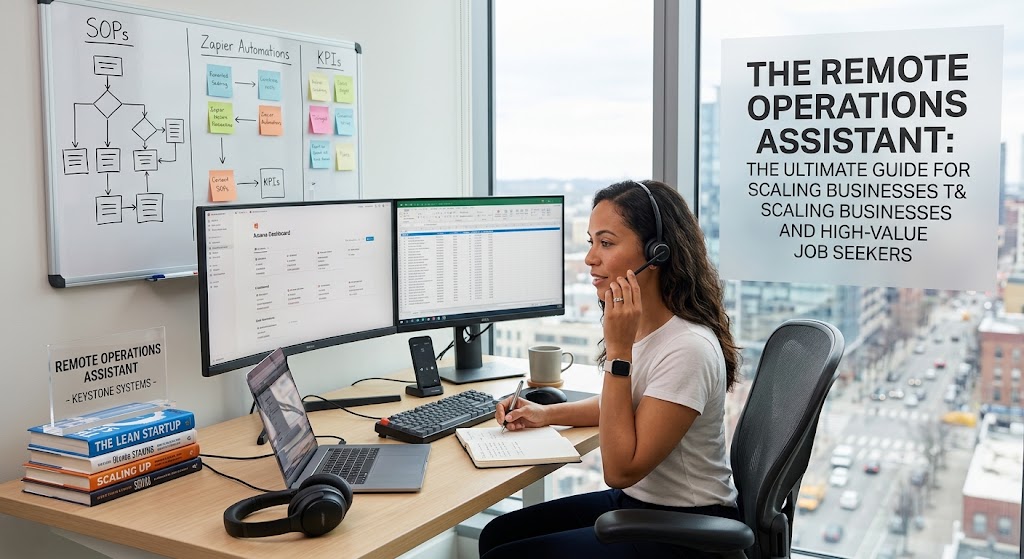
In the modern digital economy, the traditional bottleneck for growing businesses isn’t a lack of capital or product-market fit—it is operational capacity. As companies scale, founders and Directors of Operations are routinely buried under complex workflows, cross-departmental coordination, and data fragmentation. Enter the Remote Operations Assistant (or EA to the Director of Operations).
This comprehensive guide explores this high-impact role from two critical perspectives: business owners and agencies looking to hire, and professionals seeking to land high-paying remote roles.
Part 1: For Employers and Agencies – Why You Need an Operations EA
A standard Virtual Assistant (VA) typically handles repetitive, low-context administrative tasks like email sorting, calendar management, and basic data entry. While valuable, they cannot untangle broken internal workflows or manage project management software across cross-functional remote teams.
An Operations Assistant acts as the strategic extension of the Director of Operations. Here is why hiring one transforms a scaling business:
- Reclaiming Leadership Time: Directors of Operations spend up to 40% of their week on status updates and pipeline tracking. An operations EA takes ownership of reporting dashboards, freeing leadership to focus on high-level growth strategy.
- Standard Operating Procedures (SOP) Architecture: Instead of reinventing the wheel, an operations-focused EA documents, refines, and implements repeatable company processes.
- Cross-Tool Integration & Tech Management: Modern businesses run on dozens of software tools. Your EA ensures data flows seamlessly between your CRM, project management boards (like Asana or Notion), and communication channels (Slack).
What to Look for When Hiring
When posting your agency requirements or opening a remote listing, look for candidates who exhibit:
- Systemic Thinking: They don’t just complete a task; they ask how the task can be automated or optimized for the future.
- Advanced Software Literacy: Familiarity with automation tools (Zapier), advanced spreadsheets, and modern project management software.
- Proactive Communication: High emotional intelligence and the ability to anticipate bottlenecks before they stall company momentum.
Part 2: For Remote Workers – How to Land a High-Paying Operations EA Role
If you are a remote professional looking to break away from low-paying general admin tasks, positioning yourself as an Operations Assistant or EA to a Director is your fastest path to commanding premium rates ($20–$40+/hr).
Core Skills You Must Master
- Project Management Frameworks: Master tools like Notion, Asana, Monday.com, and Trello. Know how to build workflows from scratch, assign dependencies, and track KPIs.
- Data & Reporting: Be comfortable cleaning data sets, building weekly performance reports in Google Sheets or Excel, and summarizing metrics for leadership.
- Process Documentation: Learn how to record loom videos and write clear, step-by-step SOPs that anyone on the team can follow.
How to Position Yourself
- Stop marketing yourself as a “general VA.” Build your portfolio around efficiency, problem-solving, and systems.
- Highlight case studies where you saved a previous client hours of time each week.
- Tailor your resume to speak the language of management: talk about throughput, workflows, resource allocation, and accountability metrics.
Conclusion: Bridging Talent and Enterprise
Whether you are a startup founder trying to claw back your weekends or an ambitious remote professional looking to scale your career, the Remote Operations Assistant role is the anchor of modern business efficiency. By recognizing the immense strategic value of operational support, companies build resilient remote teams, and workers secure rewarding, future-proof careers.
Leave a Reply
You must be logged in to post a comment.