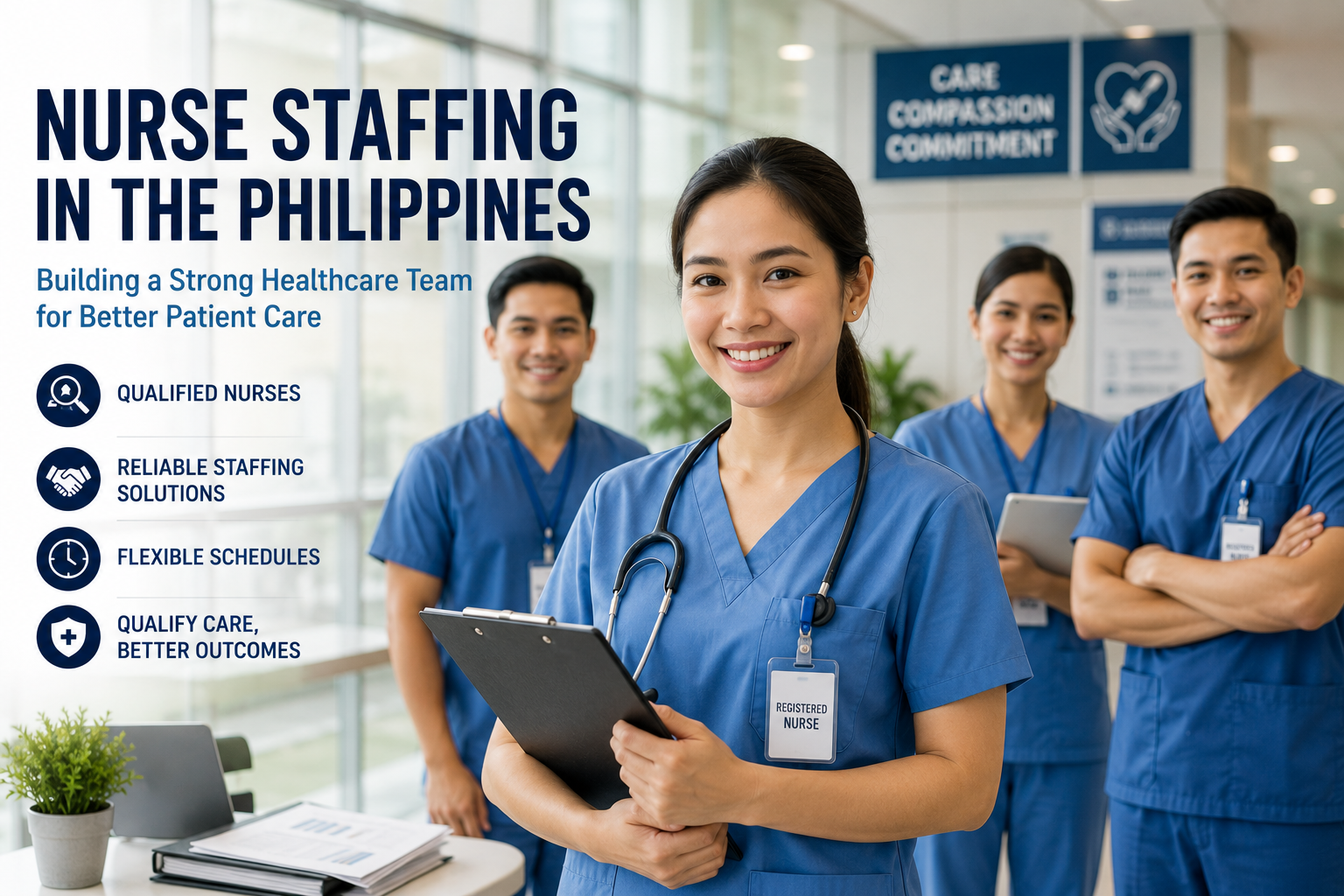
Finding the right nursing staff is an important part of operating a healthcare facility.
Hospitals, clinics, residential care facilities, home-care providers, and other healthcare organizations need nurses who can provide appropriate patient care while working effectively with doctors, administrators, caregivers, and other healthcare professionals.
However, nurse staffing involves more than simply finding someone who is available to work.
Healthcare organizations need to consider qualifications, professional registration, experience, availability, workload, communication, scheduling, and the specific requirements of the facility.
For organizations looking for nurse staffing in the Philippines, having a structured approach can make recruitment and staffing decisions easier.
This guide explains the basics of nurse staffing, what healthcare facilities should consider when looking for nursing professionals, and how local healthcare staffing providers can fit into the process.
Important: This article is about healthcare staffing and recruitment. It is not a substitute for professional medical, legal, employment, or regulatory advice. Healthcare facilities should verify applicable Philippine requirements before hiring or assigning nursing personnel.
What Is Nurse Staffing?
Nurse staffing refers to finding, hiring, scheduling, and managing nursing professionals needed to provide healthcare services.
Depending on the organization, staffing requirements can include:
- Registered nurses
- Nursing assistants and support personnel where applicable
- Private-duty nurses
- Home-care nurses
- Clinic nurses
- Hospital nurses
- Temporary nursing staff
- Full-time nursing staff
- Part-time nursing staff
- Shift-based nursing staff
The appropriate staffing model depends on the type of facility and the services it provides.
Why Nurse Staffing Matters
Adequate staffing can help healthcare organizations maintain consistent operations.
Nursing staff may be responsible for important activities such as:
- Patient monitoring
- Medication-related responsibilities within their professional scope
- Documentation
- Patient education
- Communication with healthcare teams
- Basic patient care
- Coordination of care
- Supporting physicians and other healthcare professionals
Insufficient staffing can place additional pressure on existing employees and affect how efficiently a facility operates.
For that reason, staffing should be planned rather than treated as an emergency whenever possible.
Types of Facilities That May Need Nursing Staff
Nurse staffing needs can vary significantly depending on the healthcare setting.
Potential employers include:
Hospitals
Hospitals may require nursing professionals across multiple departments and shifts.
Clinics
Outpatient clinics may require nurses for consultations, procedures, patient monitoring, and administrative healthcare functions within their role.
Home Healthcare Providers
Home-care organizations may require nurses to provide care in patients’ homes.
Residential Care Facilities
Facilities caring for older adults or people requiring ongoing assistance may need nursing personnel depending on their services and applicable requirements.
Specialty Healthcare Facilities
Certain healthcare organizations may require nurses with relevant experience in specialized areas.
Private Patients
Families may seek private-duty nursing services for appropriate home-care situations.
Determine Your Staffing Requirements First
Before recruiting, a healthcare organization should identify what it actually needs.
Consider:
- Number of positions
- Required shifts
- Full-time or part-time requirements
- Temporary or permanent staffing
- Required experience
- Required specialty
- Location
- Start date
- Expected workload
- Scope of responsibilities
A clear staffing requirement makes recruitment more efficient.
Full-Time vs Part-Time Nurse Staffing
Healthcare organizations may use different staffing arrangements.
Full-Time Staffing
Full-time employees can provide greater continuity and may be appropriate for facilities with consistent staffing requirements.
Part-Time Staffing
Part-time nurses can provide additional flexibility where staffing requirements vary.
Temporary Staffing
Temporary staffing can help organizations address short-term needs such as:
- Employee leave
- Seasonal demand
- Temporary increases in patient volume
- Special projects
The appropriate arrangement depends on the organization’s operational and employment requirements.
Private Duty Nursing
Private-duty nursing generally involves providing nursing care to an individual patient rather than working as part of a large hospital ward.
Depending on the patient’s needs and applicable professional requirements, private nursing services may involve:
- Patient monitoring
- Care coordination
- Assistance with prescribed care
- Documentation
- Communication with family members and healthcare providers
The exact responsibilities should be clearly established before the assignment begins.
Home Healthcare Nursing
Home healthcare allows appropriate patients to receive certain healthcare services in their homes.
For staffing purposes, organizations should consider:
- Patient needs
- Location
- Travel time
- Shift requirements
- Required nursing experience
- Emergency procedures
- Communication with the supervising healthcare team
Home-based assignments can require different staffing considerations from hospital work.
How to Find Nurses in the Philippines
Healthcare organizations can use several recruitment channels.
These may include:
- Direct recruitment
- Professional networks
- Referrals
- Healthcare job platforms
- Recruitment agencies
- Nursing staffing agencies
- Local business directories
- Professional organizations
When recruiting, the organization should verify the candidate’s qualifications and suitability for the specific position.
Verify Professional Credentials
Healthcare staffing requires careful credential verification.
Before assigning a nurse to professional duties, the hiring organization should verify applicable:
- Professional registration
- Education
- Training
- Experience
- Certifications
- Employment history
- References
The exact requirements depend on the position and healthcare setting.
Organizations should follow applicable Philippine laws, regulations, and professional requirements.
Check Relevant Nursing Experience
Not every nurse has the same experience.
A healthcare facility may need someone with experience in:
- Hospital nursing
- Clinic nursing
- Home healthcare
- Elder care
- Pediatric care
- Critical care
- Surgical care
- Emergency settings
- Other specialized areas
Match the candidate’s experience to the position rather than hiring based only on general nursing qualifications.
Nurse Staffing for Clinics
Smaller clinics may have different staffing requirements from hospitals.
A clinic may need nursing staff to support:
- Patient intake
- Vital-sign monitoring
- Patient education
- Clinical procedures within the nurse’s scope
- Documentation
- Physician support
- Follow-up coordination
Before hiring, define the exact responsibilities and working schedule.
Nurse Staffing for Hospitals
Hospitals generally have more complex staffing requirements.
Depending on the department, staffing may involve different levels of experience and specialty knowledge.
Hospital staffing plans may need to consider:
- Department
- Shift
- Patient volume
- Required skills
- Experience
- Coverage
- Supervisory structure
Healthcare organizations should develop staffing models appropriate for their facility and applicable requirements.
Nurse Staffing for Home Care
Home-care organizations need to consider factors that don’t necessarily apply to hospital assignments.
These can include:
- Patient location
- Travel
- Home environment
- Shift duration
- Family communication
- Emergency procedures
- Documentation
- Continuity of care
Matching the right nurse to the patient’s needs is particularly important for long-term assignments.
What to Include in a Nurse Job Description
A clear job description helps attract appropriate candidates.
Include:
Position
Example:
Registered Nurse
Location
Identify the city and work location.
Schedule
Specify:
- Day shift
- Night shift
- Rotating shifts
- Weekend requirements
- Hours per shift
Responsibilities
Explain the expected duties.
Qualifications
Identify required professional credentials and experience.
Preferred Experience
Mention any specialty or setting experience.
Compensation
If appropriate, provide salary or compensation information.
Benefits
Explain applicable benefits.
Application Process
Provide clear instructions for applying.
Why Location Matters in Nurse Staffing
Healthcare staffing is often highly location-dependent.
A nurse may be qualified but unavailable for a position because the facility is too far from their home.
For this reason, employers should identify:
- City
- Facility location
- Transportation considerations
- Shift schedule
Local recruitment can sometimes make staffing easier.
Nurse Staffing in Davao City
Davao City is a major urban center with hospitals, clinics, healthcare facilities, and other medical businesses.
Organizations searching for nursing personnel can use location-specific recruitment terms such as:
nurse staffing Davao City
nurses for hire Davao
nursing recruitment Davao
healthcare staffing Davao
The specific staffing requirements will depend on the facility and position.
Nurse Staffing in General Santos City
Healthcare organizations in General Santos City can use local searches such as:
nurse staffing General Santos City
nurses for hire General Santos
nursing recruitment GenSan
healthcare staffing General Santos
Local staffing can be useful when organizations need personnel who can reliably report to a facility or serve patients within the surrounding area.
How Staffing Agencies Can Help
A nurse staffing or healthcare recruitment agency may help organizations identify candidates for available positions.
Depending on the agency’s services, it may assist with:
- Candidate sourcing
- Initial screening
- Interview coordination
- Credential verification
- Placement
- Temporary staffing
- Permanent recruitment
Healthcare organizations should still conduct their own appropriate due diligence before assigning personnel.
Questions to Ask a Nurse Staffing Agency
Before working with an agency, ask:
- What types of nurses do you recruit?
- Which locations do you serve?
- Do you provide temporary staffing?
- Do you provide permanent recruitment?
- How are candidate credentials verified?
- What experience do your candidates have?
- How quickly can you provide candidates?
- What are your staffing fees?
- What happens if a candidate leaves?
- How are replacements handled?
- What documentation is provided?
- What responsibilities remain with the hiring facility?
How to Evaluate a Nursing Candidate
Recruitment shouldn’t end with reviewing a résumé.
Depending on the position, evaluate:
- Professional qualifications
- Relevant experience
- Communication
- Reliability
- Clinical background
- References
- Availability
- Location
- Ability to work required shifts
Use a consistent recruitment process for all candidates.
Nurse Staffing and Shift Planning
Scheduling is an important part of staffing.
A facility may need to cover:
- Morning shifts
- Afternoon shifts
- Night shifts
- Weekends
- Holidays
- Leave coverage
Avoid creating schedules that consistently place excessive workloads on a small number of employees.
Staffing plans should reflect the organization’s actual patient-care requirements and applicable regulations.
Avoid Last-Minute Staffing Whenever Possible
Emergency staffing situations can be difficult.
A nurse may suddenly become unavailable because of:
- Illness
- Leave
- Personal circumstances
- Resignation
Maintaining an appropriate staffing plan and backup options can help reduce disruption.
Organizations that frequently experience shortages should examine the underlying reason rather than relying indefinitely on last-minute replacements.
Nurse Retention Is Part of Staffing
Recruiting nurses is only one part of the problem.
Keeping qualified nursing professionals can also help organizations maintain continuity.
Factors that may influence retention include:
- Fair compensation
- Reasonable scheduling
- Supportive management
- Professional development
- Clear responsibilities
- Safe working conditions
- Respectful workplace culture
Organizations should evaluate their working environment when they experience repeated staffing difficulties.
Communication Between Nurses and Management
Clear communication is essential.
Nursing staff should know:
- Their responsibilities
- Their schedule
- Reporting structure
- Documentation requirements
- Escalation procedures
- Who to contact when problems occur
Likewise, management should have a clear process for receiving staffing concerns.
Keep Staffing Records Organized
Healthcare organizations should maintain appropriate records related to staffing and employment.
Depending on the organization, records may include:
- Credentials
- Employment documentation
- Training
- Schedules
- Attendance
- Performance information
- Required compliance documentation
Follow applicable privacy, employment, healthcare, and recordkeeping requirements.
Don’t Hire Based Only on Availability
A candidate being immediately available doesn’t necessarily mean they’re the right candidate.
Consider:
Qualifications + Experience + Availability + Location + Role Fit
rather than availability alone.
This is particularly important when patient care is involved.
Finding Nursing and Healthcare Services Through Search Hub
As Search Hub’s healthcare directory develops, organizations and consumers can use the platform to discover local healthcare-related businesses and services.
Potential categories include:
- Doctors
- Clinics
- Nurses
- Nursing agencies
- Healthcare staffing
- Dental clinics
- Diagnostic laboratories
- Pharmacies
- Home healthcare providers
Browse:
Search Hub Local Business Services
Frequently Asked Questions
What is nurse staffing?
Nurse staffing involves recruiting, hiring, scheduling, and managing nursing professionals to meet the needs of healthcare organizations or patients.
Where can healthcare facilities find nurses in the Philippines?
Organizations can recruit directly, use professional networks, recruitment platforms, staffing agencies, referrals, and local business directories.
What should a healthcare facility check before hiring a nurse?
The organization should verify applicable professional credentials, education, experience, references, and suitability for the specific position.
Can staffing agencies provide temporary nurses?
Some agencies offer temporary or contract staffing, while others focus on permanent recruitment. Organizations should confirm the services provided by each agency.
What factors should be considered when staffing a clinic?
Consider the number of patients, operating hours, required services, nurse qualifications, shift requirements, location, and applicable healthcare requirements.
Is nurse staffing available in Davao City?
Healthcare organizations can search for nursing recruitment and staffing providers serving Davao City.
Can healthcare organizations find nursing staff in General Santos City?
Organizations can use local searches such as “nurse staffing General Santos City” or “nurses for hire General Santos” to identify potential staffing providers.
Final Thoughts
Effective nurse staffing in the Philippines involves more than filling an empty position.
Healthcare organizations need to identify their actual staffing requirements, define the position clearly, verify professional credentials, assess relevant experience, and match candidates to the needs of the facility.
Location and scheduling are also important, particularly for home healthcare and facilities operating multiple shifts.
Recruitment agencies and staffing providers can help organizations find candidates, but healthcare employers should still conduct appropriate verification and due diligence.
For healthcare businesses looking for local staffing and service providers, Search Hub can provide another way to discover businesses by category and location.