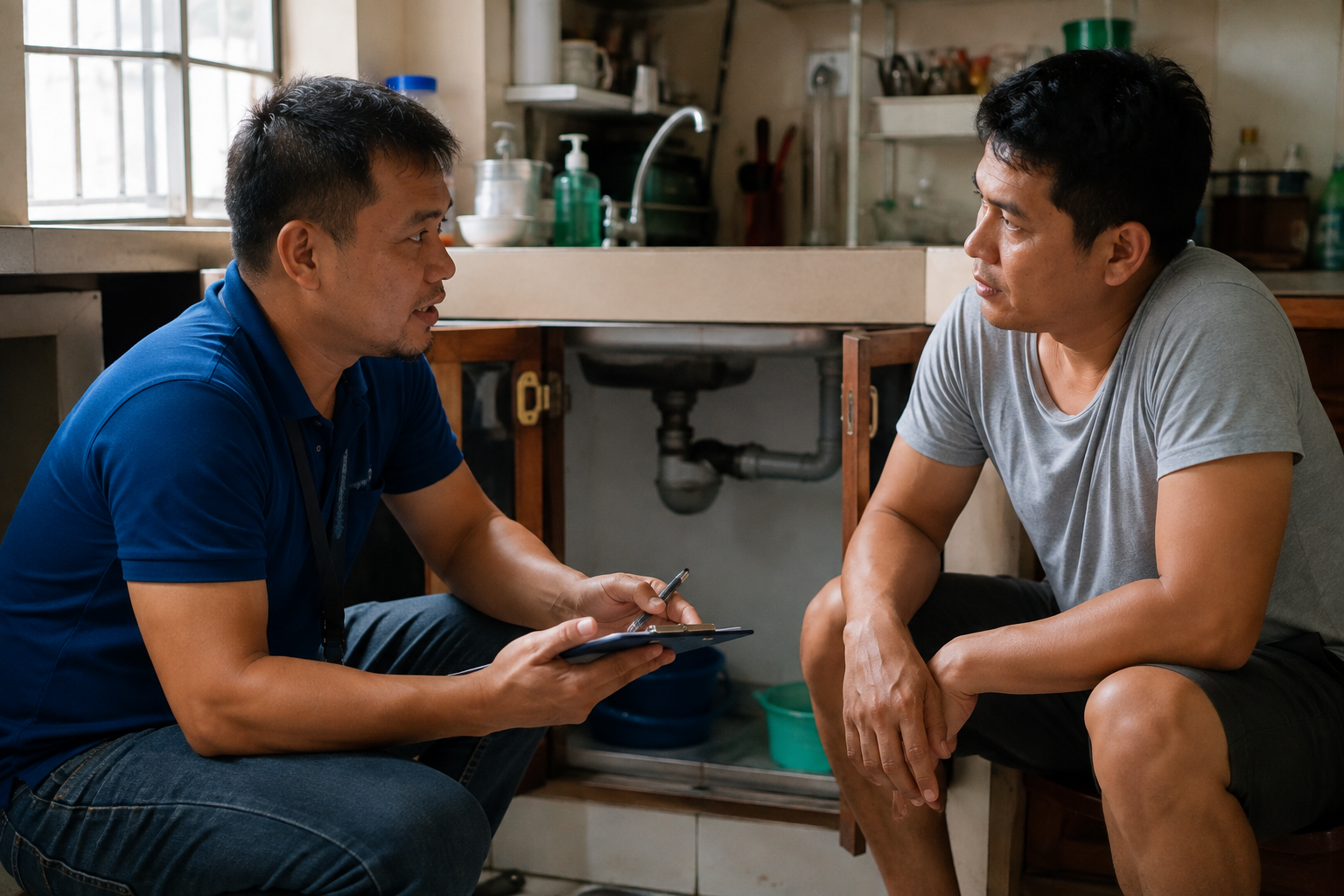
When a faucet starts leaking or the kitchen sink refuses to drain, the first question many homeowners ask is:
“Magkano kaya ang tubero?”
Unfortunately, there isn’t one price that applies to every plumbing job.
A simple faucet repair is very different from replacing a section of pipe hidden inside a wall. Location, accessibility, materials, urgency, and the complexity of the repair can all change the final bill.
Current 2026 pricing references show that minor plumbing jobs in the Philippines can start in the hundreds of pesos, while more complicated repairs and emergency work can reach several thousand pesos. One current national pricing guide puts common minor repairs around ₱350–₱1,500, with unclogging around ₱500–₱2,500, before considering materials and location-specific differences.
So rather than looking for one “standard plumber price,” it makes more sense to understand what you’re actually paying for.
Common Plumbing Repairs and Their Costs

Here are useful budgeting ranges, not fixed prices:
| Plumbing job | Indicative range |
|---|---|
| Minor leak/faucet repair | ₱350–₱1,500 |
| Drain/toilet unclogging | ₱500–₱2,500 |
| Toilet replacement labor | ₱1,000–₱3,500 |
| Water-heater installation labor | ₱800–₱3,000 |
| Emergency/concealed leak work | Can reach several thousand pesos |
These figures vary considerably by location, provider, materials, access, and urgency. They should be used as a starting point for comparison—not as a guaranteed quote.
For example, a Metro Manila plumbing provider currently publishes declogging prices starting at ₱4,500 for a kitchen sink line and ₱5,000 for a floor drain, illustrating why the exact scope of work matters so much.
Why Do Plumbing Prices Vary So Much?
1. The Type of Problem
Replacing a worn faucet washer is relatively straightforward.
Finding a concealed pipe leak is another story.
A plumber may need additional equipment, more labor, or to open part of a wall or floor to reach the problem.
2. Materials
The labor may be only part of your bill.
You could also need:
- PVC pipes
- Fittings
- Valves
- Flexible hoses
- Faucet parts
- Sealants
- Drain components
- Replacement fixtures
Ask whether the quotation includes materials.
3. Accessibility
A pipe that’s easily accessible under a sink is much easier to repair than one buried inside a wall.
If the plumber needs to remove tiles, cabinets, ceilings, or other materials, the total cost can increase.
4. Your Location
Rates aren’t identical throughout the Philippines.
A service provider in Metro Manila may have different operating costs from one serving a provincial municipality.
Transportation can also affect the quote.
5. Emergency Service
A leaking pipe at 2 PM is one thing.
A burst pipe at midnight is another.
Emergency and after-hours plumbing services can cost more because you’re paying for immediate response.
How Much Should You Expect to Pay for a Plumber’s Labor?
A current 2026 national pricing reference places skilled plumber day rates around ₱800–₱2,000, while smaller jobs are often priced per job rather than by the hour.
Don’t assume that a low labor quote means you’ll get the lowest total price.
A ₱500 labor quote can become considerably more expensive if materials, transportation, diagnostic work, or additional repairs are added later.
That’s why comparing the complete scope is more useful than comparing one number.
Get the Quote in Writing

Before work begins, ask for a simple breakdown.
For example:
Labor: ₱1,000
PVC fittings: ₱350
Replacement valve: ₱450
Transportation: ₱200
Total: ₱2,000
The actual numbers will vary, but a breakdown makes it easier to understand what you’re paying for.
For larger jobs, ask whether the quote includes:
- Materials
- Labor
- Removal of old parts
- Cleanup
- Transportation
- Testing
- Warranty
Should You Hire the Cheapest Plumber?
Not necessarily.
A plumber who gives you the cheapest price may be the right choice—but price alone doesn’t tell you everything.
Consider:
- Experience
- Communication
- Scope of work
- Reviews
- Location
- Availability
- Warranty
- Whether the quotation is clear
For permit-related work or major plumbing design and installation, make sure the appropriate licensed professional is involved.
When Is a Plumbing Problem an Emergency?
Call for urgent help when you have situations such as:
- A burst pipe
- Water rapidly entering the house
- A major leak that cannot be stopped
- Sewage backing up into the home
- A leak near electrical equipment
- A serious water supply failure
If you can safely do so, shutting off the main water supply while waiting for help can limit damage.
Final Thoughts

There isn’t a single “plumber rate” in the Philippines.
A minor repair might cost a few hundred pesos, while concealed leaks, major replacements, emergency work, and jobs requiring significant materials can cost several thousand pesos.
The smartest approach is to describe the problem clearly, ask what is included, compare quotations, and avoid choosing based on price alone.
If you need a plumber, explore the Plumbing services category on Search Hub and compare available local providers.