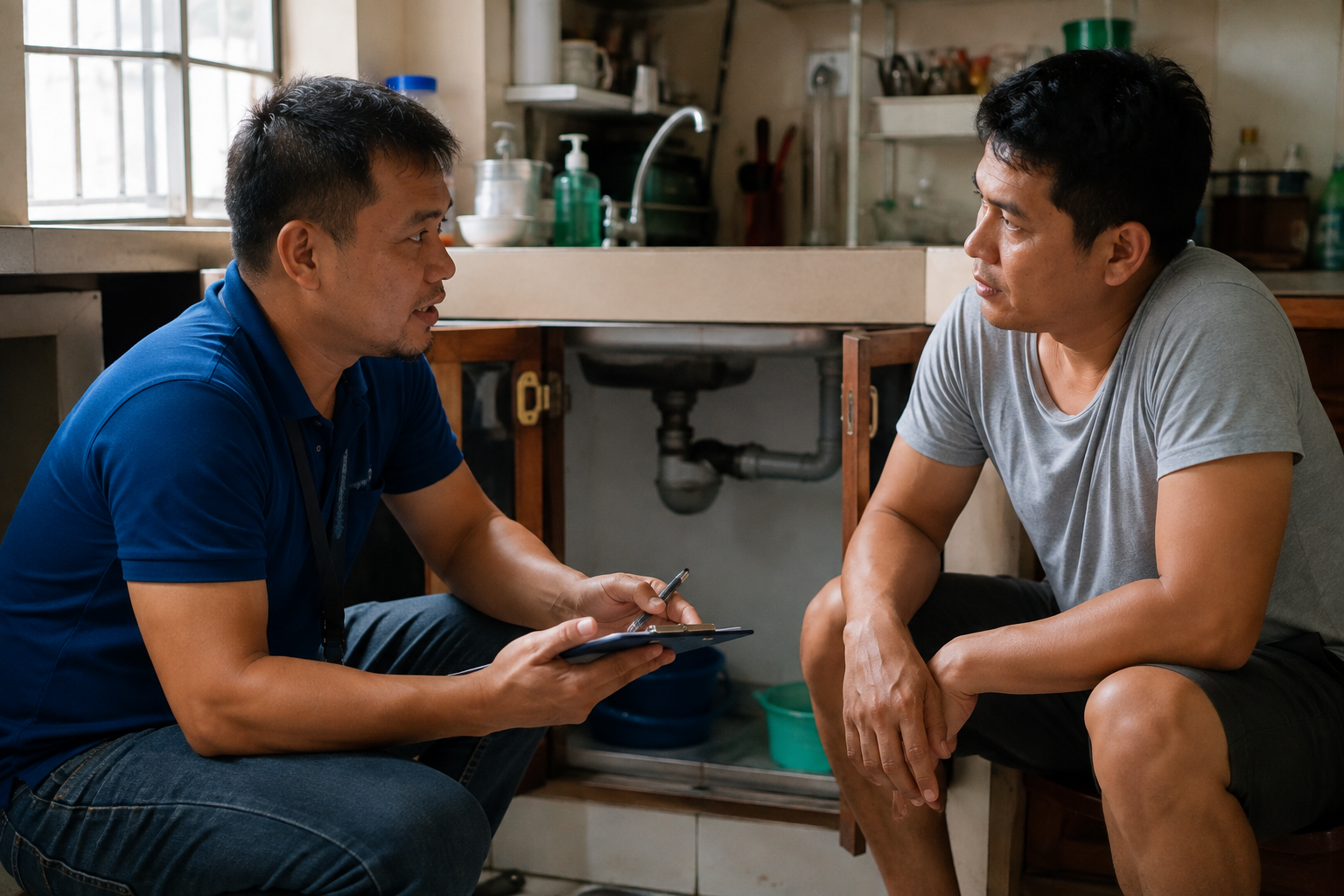
When a faucet starts leaking or the kitchen sink refuses to drain, the first question many homeowners ask is:
“Magkano kaya ang tubero?”
Unfortunately, there isn’t one price that applies to every plumbing job.
A simple faucet repair is very different from replacing a section of pipe hidden inside a wall. Location, accessibility, materials, urgency, and the complexity of the repair can all change the final bill.
Current 2026 pricing references show that minor plumbing jobs in the Philippines can start in the hundreds of pesos, while more complicated repairs and emergency work can reach several thousand pesos. One current national pricing guide puts common minor repairs around ₱350–₱1,500, with unclogging around ₱500–₱2,500, before considering materials and location-specific differences.
So rather than looking for one “standard plumber price,” it makes more sense to understand what you’re actually paying for.
Common Plumbing Repairs and Their Costs
A leaking pipe may require different materials and labor depending on where the problem occurs.
Here are useful budgeting ranges, not fixed prices:
Plumbing job
Indicative range
Minor leak/faucet repair
₱350–₱1,500
Drain/toilet unclogging
₱500–₱2,500
Toilet replacement labor
₱1,000–₱3,500
Water-heater installation labor
₱800–₱3,000
Emergency/concealed leak work
Can reach several thousand pesos
These figures vary considerably by location, provider, materials, access, and urgency. They should be used as a starting point for comparison—not as a guaranteed quote.
For example, a Metro Manila plumbing provider currently publishes declogging prices starting at ₱4,500 for a kitchen sink line and ₱5,000 for a floor drain, illustrating why the exact scope of work matters so much.
Why Do Plumbing Prices Vary So Much?
1. The Type of Problem
Replacing a worn faucet washer is relatively straightforward.
Finding a concealed pipe leak is another story.
A plumber may need additional equipment, more labor, or to open part of a wall or floor to reach the problem.
2. Materials
The labor may be only part of your bill.
You could also need:
PVC pipes
Fittings
Valves
Flexible hoses
Faucet parts
Sealants
Drain components
Replacement fixtures
Ask whether the quotation includes materials.
3. Accessibility
A pipe that’s easily accessible under a sink is much easier to repair than one buried inside a wall.
If the plumber needs to remove tiles, cabinets, ceilings, or other materials, the total cost can increase.
4. Your Location
Rates aren’t identical throughout the Philippines.
A service provider in Metro Manila may have different operating costs from one serving a provincial municipality.
Transportation can also affect the quote.
5. Emergency Service
A leaking pipe at 2 PM is one thing.
A burst pipe at midnight is another.
Emergency and after-hours plumbing services can cost more because you’re paying for immediate response.
How Much Should You Expect to Pay for a Plumber’s Labor?
A current 2026 national pricing reference places skilled plumber day rates around ₱800–₱2,000, while smaller jobs are often priced per job rather than by the hour.
Don’t assume that a low labor quote means you’ll get the lowest total price.
A ₱500 labor quote can become considerably more expensive if materials, transportation, diagnostic work, or additional repairs are added later.
That’s why comparing the complete scope is more useful than comparing one number.
Get the Quote in Writing
Ask what labor, materials, transportation, and other charges are included before approving a repair.
The actual numbers will vary, but a breakdown makes it easier to understand what you’re paying for.
For larger jobs, ask whether the quote includes:
Materials
Labor
Removal of old parts
Cleanup
Transportation
Testing
Warranty
Should You Hire the Cheapest Plumber?
Not necessarily.
A plumber who gives you the cheapest price may be the right choice—but price alone doesn’t tell you everything.
Consider:
Experience
Communication
Scope of work
Reviews
Location
Availability
Warranty
Whether the quotation is clear
For permit-related work or major plumbing design and installation, make sure the appropriate licensed professional is involved.
When Is a Plumbing Problem an Emergency?
Call for urgent help when you have situations such as:
A burst pipe
Water rapidly entering the house
A major leak that cannot be stopped
Sewage backing up into the home
A leak near electrical equipment
A serious water supply failure
If you can safely do so, shutting off the main water supply while waiting for help can limit damage.
Final Thoughts
Leaks hidden behind walls or floors can require additional work to locate and repair.
There isn’t a single “plumber rate” in the Philippines.
A minor repair might cost a few hundred pesos, while concealed leaks, major replacements, emergency work, and jobs requiring significant materials can cost several thousand pesos.
The smartest approach is to describe the problem clearly, ask what is included, compare quotations, and avoid choosing based on price alone.
A faucet drips every few seconds. There’s a dark patch appearing on the ceiling. One electrical outlet has stopped working. Your air conditioner isn’t cooling the room like it used to.
It’s easy to think, I’ll deal with it later.
The problem is that “later” can sometimes turn a simple repair into a much bigger one.
Living in the Philippines also means our homes have to deal with plenty of heat, humidity, heavy rain, storms, and, in some areas, flooding. Those conditions can make certain maintenance problems develop faster than they might elsewhere.
Not every problem requires an emergency repair, but these are ten issues that are worth paying attention to before they become expensive.
1. A Leaking Roof
A leaking pipe and water-damaged ceiling can be signs of a home repair problem that should not be ignored.
A small roof leak might only show up as a tiny stain on the ceiling during heavy rain.
It can be tempting to put a bucket underneath it and forget about it once the rain stops.
But water doesn’t always stay where you can see it.
A leak can gradually damage ceiling materials, insulation, wooden components, and other parts of the house. Persistent moisture can also contribute to mold growth.
If you notice:
Water stains on the ceiling
Dripping during rain
Damp areas around windows or walls
Peeling paint
Sagging ceiling material
it’s worth finding the source rather than simply covering the stain.
A roofing professional can determine whether the problem is a damaged roof sheet, flashing, seal, gutter, or another part of the roof system.
2. Slow or Frequently Clogged Drains
A drain that takes longer than usual to empty may seem like a minor inconvenience.
But if it keeps happening, there’s probably a reason.
Hair, grease, food particles, soap residue, and other materials can gradually restrict a drainage pipe. In some cases, the problem can become a complete blockage.
Watch for:
Water draining slowly
Gurgling sounds
Unpleasant smells
Water backing up
Repeatedly clogged sinks or showers
Pouring something down the drain may temporarily improve the situation, but repeated blockages are a sign that the underlying problem needs attention.
3. A Constantly Dripping Faucet
One dripping faucet doesn’t sound like a major household problem.
And financially, a few drops here and there may not seem significant.
But a faucet that continues leaking can indicate a worn-out washer, valve, cartridge, or another component that needs replacing.
More importantly, persistent leaks can eventually damage cabinets, countertops, walls, or flooring depending on where the water is escaping.
If tightening the handle doesn’t solve the problem, it’s probably time to have it checked.
4. Electrical Outlets That Get Hot
This one deserves more attention than most homeowners realize.
If an electrical outlet, switch, plug, or extension cord becomes unusually hot during normal use, don’t simply ignore it.
Signs of electrical problems should be checked by a qualified professional to help keep your home safe.
Other warning signs include:
Burning smells
Buzzing or crackling
Sparks
Discoloration around an outlet
Flickering lights
Frequently tripped breakers
Electrical problems can have serious consequences, so this isn’t a good area for guesswork or improvised repairs.
If something doesn’t seem right, have a qualified electrician inspect it.
If you see smoke, active sparking, or signs of an electrical fire, treat it as an emergency and prioritize safety over troubleshooting.
5. An Air Conditioner That Isn’t Cooling Properly
Regular air conditioner cleaning can help maintain airflow and keep cooling problems from getting worse.
Air conditioning gets plenty of use in many Philippine homes, particularly during the hottest months.
If your air conditioner gradually becomes less effective, don’t automatically assume you simply need to turn the temperature down.
Possible causes can include dirty filters, restricted airflow, insufficient refrigerant, drainage problems, or components that need servicing.
Signs that your air conditioner may need attention include:
Weak airflow
Water leaking from the indoor unit
Unusual noises
Bad smells
Longer cooling times
Increasing electricity consumption
Regular cleaning and maintenance can also help prevent small problems from becoming bigger ones.
6. Mold or Persistent Dampness
Mold and persistent dampness can be signs of an underlying moisture problem that should not be ignored.
Humidity is a fact of life in many parts of the Philippines.
But there’s a difference between a humid room and a persistent moisture problem.
If you repeatedly see mold, mildew, peeling paint, or damp walls, don’t just clean the visible surface and assume the problem is gone.
There may be an underlying source of moisture such as:
A plumbing leak
Roof leakage
Poor ventilation
Condensation
Water entering through walls
Drainage problems
Cleaning the mold may improve the appearance temporarily, but identifying and addressing the moisture source is often the more important step.
7. Cracked or Damaged Plumbing Pipes
Some plumbing problems announce themselves with a large leak.
Others don’t.
A small leak inside a wall, underneath a sink, or beneath a floor can go unnoticed for quite a while.
Keep an eye out for:
Unexpectedly wet areas
Water stains
Musty smells
Sudden changes in water pressure
Unexplained increases in water consumption
Damp cabinets or walls
If you suspect a hidden leak, getting it investigated early can potentially prevent more extensive water damage.
8. Damaged Gutters and Poor Drainage
During a heavy Philippine rainstorm, your home’s drainage system can suddenly become very important.
Gutters and downspouts help move rainwater away from the building.
If they’re blocked, damaged, or poorly positioned, water may collect around areas where you don’t want it.
Look for:
Overflowing gutters
Plants or debris growing inside gutters
Water running down exterior walls
Pooling water around the house
Damaged downspouts
Soil erosion near drainage outlets
Keeping gutters and drainage areas clear is one of those relatively simple maintenance jobs that can help prevent much larger problems.
9. Termite or Other Pest Damage
Not every pest problem is immediately obvious.
Termites, for example, can damage wooden parts of a home without producing an obvious warning sign from the outside.
Pay attention to:
Damaged or hollow-sounding wood
Small holes
Mud tubes
Discarded wings
Doors or windows that suddenly become difficult to close
Wood that appears unusually weak
If you suspect an infestation, don’t wait until significant damage becomes visible.
A pest-control professional can inspect the affected areas and determine what you’re dealing with.
10. Peeling Paint or Damaged Walls
Peeling paint isn’t always just a cosmetic problem.
Sometimes it’s the first visible sign that moisture is getting into a wall.
If paint repeatedly bubbles, cracks, or peels in the same area, repainting it may only hide the problem temporarily.
Check for possible causes such as:
Water leaks
Roof problems
Plumbing issues
Condensation
Exterior water penetration
Fixing the source before repainting usually makes more sense than repeatedly painting over the damage.
When Should You Call a Professional?
A useful rule is to distinguish between routine maintenance and problems where professional help makes more sense.
You may be comfortable handling simple tasks such as replacing an air-conditioner filter, cleaning a gutter, or tightening a loose fitting.
But it’s better to call a professional when the problem involves:
Electricity Electrical work can be dangerous if you’re not qualified to perform it.
Gas Suspected gas leaks require immediate attention and should not be treated as a DIY repair.
Structural problems Significant cracks, movement, sagging, or other structural concerns deserve proper assessment.
Major plumbing leaks Especially when water is entering walls, ceilings, or electrical areas.
Roof work at height A repair isn’t worth risking a fall.
Persistent pest infestation Especially when there may already be structural damage.
Knowing when not to DIY is part of good home maintenance too.
Don’t Wait Until a Small Repair Becomes a Big One
Home maintenance isn’t about fixing every little thing the moment it happens.
Sometimes a loose cabinet handle really can wait.
The important thing is recognizing the problems that can spread or become more expensive if ignored.
A small roof leak can lead to water damage.
A slow drain can become a blockage.
A minor plumbing leak can damage walls or cabinets.
A neglected electrical problem can become a safety hazard.
And an air conditioner that simply “isn’t working as well as before” may eventually stop working altogether.
The earlier you identify the problem, the more options you usually have.
Finding Local Home Services
When a repair is beyond a simple DIY job, finding the right local professional is the next step.
Search Hub’s Home Services directory is designed to help people discover local service providers and businesses.
The goal isn’t simply to find the first service provider you see. Take the time to compare the available information, check the provider’s location, ask questions, and understand what the work involves before agreeing to a job.
Final Thoughts
Your house doesn’t have to be perfect to be well maintained.
What matters is paying attention to changes and dealing with problems before they have a chance to grow.
A dripping faucet, damp wall, clogged drain, damaged gutter, or unusual electrical outlet may seem insignificant today. But if something keeps getting worse, it’s usually worth investigating.
And when a repair involves electrical systems, major plumbing, roofing, structural issues, or other potentially dangerous work, getting the right professional involved is often the safest choice.
A little maintenance today can save you a much bigger repair tomorrow.