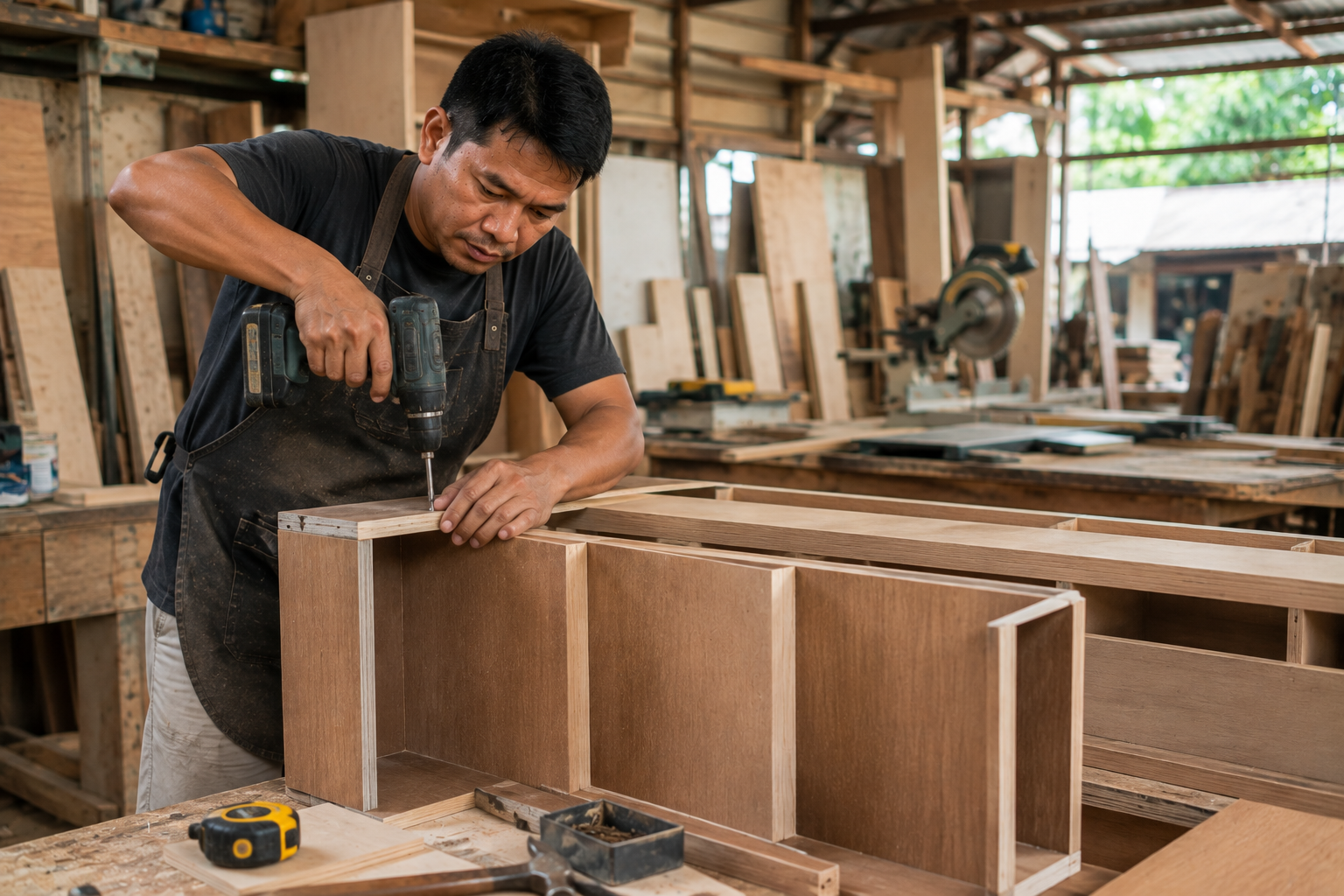
Tag: carpentry services

  • How to Find a Carpenter in General Santos City

    How to Find a Carpenter in General Santos City

    Finding a good carpenter in General Santos City can make a significant difference in the quality and durability of your home improvement project.

    Whether you’re building custom cabinets, repairing furniture, installing wooden doors, creating a built-in wardrobe, or having custom furniture made, the right carpenter can help turn your ideas into a finished project.

    But choosing a carpenter shouldn’t be based only on price.

    A carpenter’s experience, workmanship, materials, tools, communication, availability, and understanding of your project can all affect the final result.

    General Santos City, commonly known as GenSan, has a growing residential, commercial, and construction market. Homeowners and businesses may need carpentry services for everything from small repairs to complete custom interior projects.

    This guide explains how to find, evaluate, and hire a carpenter in General Santos City.


    What Services Does a Carpenter in General Santos City Provide?

    Carpenters can provide a wide range of services.

    Depending on their specialization, a local carpenter may offer:

    • Custom cabinets
    • Kitchen cabinets
    • Built-in wardrobes
    • Wooden doors
    • Tables
    • Beds
    • Desks
    • Shelves
    • TV cabinets
    • Custom furniture
    • Furniture repairs
    • Wood restoration
    • Partitions
    • Interior woodwork
    • Renovation carpentry
    • Installation services

    Not every carpenter offers every service.

    That’s why your first step should be identifying exactly what you need.


    1. Know What Carpentry Work You Need

    Before searching for a carpenter, describe your project as specifically as possible.

    Instead of searching only for:

    carpenter General Santos City

    you may get better results with:

    • custom cabinet carpenter General Santos City
    • kitchen cabinet carpenter GenSan
    • furniture maker General Santos City
    • wooden door carpenter GenSan
    • furniture repair General Santos
    • built-in wardrobe carpenter General Santos

    The more specific your search, the easier it becomes to find someone with relevant experience.


    2. Custom Cabinet Carpenters in General Santos City

    Custom cabinets are one of the most common residential carpentry projects.

    A carpenter may build:

    • Kitchen cabinets
    • Bedroom wardrobes
    • Pantry cabinets
    • Bathroom cabinets
    • TV cabinets
    • Home-office storage
    • Bookshelves
    • Built-in storage

    Custom cabinetry is useful when standard furniture doesn’t fit your space properly.

    A carpenter can design the cabinet around:

    • Wall dimensions
    • Ceiling height
    • Windows
    • Doors
    • Plumbing
    • Electrical outlets
    • Appliances
    • Available floor space

    Before hiring a cabinet carpenter, ask to see examples of previous projects.

    For more information about choosing a cabinet specialist, read:

    How to Find a Custom Cabinet Carpenter in the Philippines


    3. Kitchen Cabinet Carpenters

    Kitchen cabinets require careful planning because they need to work around appliances and utilities.

    A kitchen cabinet project may involve:

    • Base cabinets
    • Wall cabinets
    • Drawers
    • Pantry cabinets
    • Corner cabinets
    • Appliance cabinets
    • Kitchen islands

    Your carpenter may need to consider:

    • Sink location
    • Plumbing
    • Electrical outlets
    • Refrigerator dimensions
    • Oven dimensions
    • Cooktop
    • Range hood
    • Countertop height

    Ask whether the carpenter has completed similar kitchen projects before.


    4. Built-In Wardrobes

    A built-in wardrobe can make better use of available bedroom space than standard furniture.

    A carpenter can design compartments for:

    • Hanging clothes
    • Folded clothing
    • Shoes
    • Bags
    • Accessories
    • Drawers
    • Shelves

    You can also request:

    • Sliding doors
    • Hinged doors
    • Mirrors
    • Overhead storage
    • Internal lighting

    Accurate measurement is particularly important with built-in furniture.


    5. Custom Furniture in General Santos City

    Some carpenters also specialize in custom furniture.

    Projects may include:

    • Dining tables
    • Coffee tables
    • Beds
    • Desks
    • Benches
    • Bookshelves
    • TV consoles
    • Storage furniture

    If you’re looking for a furniture specialist, ask to see actual completed furniture projects.

    A carpenter who specializes in construction work may not necessarily have the same experience as someone who builds furniture every day.

    For more information:

    Carpenter vs Furniture Maker: What’s the Difference?


    6. Wooden Door Installation and Repair

    Wooden doors are another common carpentry requirement.

    A carpenter may handle:

    • Door fabrication
    • Door installation
    • Door-frame work
    • Hinge installation
    • Lock installation
    • Door adjustments
    • Repairs
    • Finishing

    Before accepting a quotation, ask whether the price includes both fabrication and installation.

    Also clarify whether painting, staining, or varnishing is included.


    7. Furniture Repair

    Sometimes replacing furniture isn’t necessary.

    A skilled carpenter may be able to repair:

    • Broken chairs
    • Loose table joints
    • Damaged cabinets
    • Broken drawers
    • Bed frames
    • Shelves
    • Wooden doors

    For small repairs, ask how the carpenter calculates the price.

    They may charge based on:

    • Labor time
    • Materials
    • Fixed project price

    8. Renovation Carpentry

    Carpenters may also be involved in home renovations.

    This can include:

    • Wall partitions
    • Built-in cabinets
    • Shelving
    • Wooden doors
    • Decorative panels
    • Storage units
    • Interior woodwork

    If your renovation involves several trades, make sure you understand who is responsible for coordinating the different workers.


    How to Search for a Carpenter in General Santos City

    When searching online, use specific keywords.

    Examples include:

    carpenter General Santos City

    carpenter near me General Santos

    carpentry services GenSan

    custom cabinet carpenter General Santos

    kitchen cabinet carpenter GenSan

    furniture maker General Santos City

    custom furniture GenSan

    woodworking services General Santos

    You can also search through local business directories.

    Search Hub Local Business Services


    9. Check Where the Carpenter Is Located

    General Santos City covers a substantial area, so location can affect transportation and installation costs.

    Before hiring, ask:

    • Where is your workshop located?
    • Do you serve my barangay?
    • Do you perform on-site measurements?
    • Do you provide delivery?
    • Do you provide installation?
    • Is transportation included?

    A carpenter may charge additional transportation costs if the project is outside their normal service area.


    10. Look at Previous Work

    A portfolio is one of the most useful ways to evaluate a carpenter.

    Ask:

    “Can you show me some of your completed projects?”

    Look for:

    • Straight edges
    • Proper alignment
    • Clean joints
    • Smooth finishing
    • Properly installed hardware
    • Even cabinet doors
    • Properly fitted drawers
    • Good overall workmanship

    Try to find projects similar to yours.

    If you need kitchen cabinets, look at kitchens.

    If you need furniture, look at furniture.

    If you need doors, look at doors.


    11. Ask About Materials

    Material selection can significantly affect the finished project.

    Common materials include:

    • Plywood
    • MDF
    • Particle board
    • Solid wood
    • Veneer
    • Laminated boards

    Don’t simply ask:

    “Do you use plywood?”

    Ask:

    “What grade and thickness of plywood will you use?”

    Also ask what materials will be used for:

    • Doors
    • Shelves
    • Cabinet backs
    • Drawers

    For a detailed comparison of cabinet materials:

    Plywood vs MDF vs Particle Board for Cabinets


    12. Check the Hardware

    Hardware is another area where quotations can differ considerably.

    Ask about:

    • Hinges
    • Drawer slides
    • Handles
    • Knobs
    • Locks
    • Brackets
    • Soft-close systems
    • Pull-out mechanisms

    For frequently used cabinets, good hardware can improve everyday usability.

    Don’t assume that two quotations are equivalent simply because both say “hardware included.”

    Ask what hardware is actually being supplied.


    13. Ask About Finishing

    Finishing can have a major effect on the appearance of furniture and cabinetry.

    Possible finishes include:

    • Paint
    • Varnish
    • Stain
    • Clear coat
    • Laminate
    • Veneer

    Ask whether the quotation includes:

    • Sanding
    • Surface preparation
    • Primer
    • Painting
    • Sealing
    • Final coating
    • Touch-ups

    A low quotation may exclude finishing.


    14. Request a Detailed Quotation

    Before hiring a carpenter, request a written quotation.

    It should ideally include:

    • Project description
    • Dimensions
    • Materials
    • Material thickness
    • Labor
    • Hardware
    • Finishing
    • Delivery
    • Installation
    • Timeline
    • Payment terms

    Avoid accepting a vague price such as:

    “Kitchen cabinet — ₱XX,XXX.”

    You need to know exactly what you’re getting.

    For a more detailed guide:

    How to Compare Carpenter Quotations


    15. Compare Several Carpenters

    For larger projects, consider requesting two or three quotations.

    But make sure each carpenter receives the same specifications.

    For example:

    “I need approximately 12 feet of kitchen cabinets using plywood, with six drawers, laminated finish, soft-close hardware, delivery and installation.”

    Then give that same information to each carpenter.

    This makes the quotations much easier to compare.


    16. Don’t Automatically Choose the Cheapest Price

    The cheapest quotation isn’t necessarily the best value.

    One carpenter may quote less because they are using:

    • Cheaper materials
    • Basic hardware
    • Less expensive finishing
    • No delivery
    • No installation

    Another carpenter may charge more because the quotation includes higher-quality materials and more services.

    Instead of asking:

    “Who is cheapest?”

    ask:

    “What exactly is included in the price?”


    17. Ask About the Project Timeline

    Before making a deposit, ask:

    When can you start?

    and:

    When should the project be finished?

    Custom carpentry may require:

    1. Measurement
    2. Design
    3. Material purchasing
    4. Fabrication
    5. Finishing
    6. Delivery
    7. Installation

    Each stage can take time.

    Get an estimated timeline before approving the project.


    18. Understand Payment Terms

    Payment terms should be clear.

    Ask:

    • How much is the deposit?
    • When are progress payments due?
    • When is the final payment?
    • What triggers each payment?
    • How are additional costs handled?

    For larger projects, having milestone-based payments can make the arrangement easier to understand.


    19. Be Careful With Design Changes

    Changes after fabrication begins can increase the project cost.

    For example:

    • Adding drawers
    • Changing cabinet dimensions
    • Changing materials
    • Upgrading hardware
    • Changing the finish

    can require additional materials and labor.

    Always ask for the additional cost before approving a change.


    20. Check Communication

    A carpenter doesn’t need to be available every minute.

    But they should be able to communicate clearly about:

    • Project requirements
    • Materials
    • Measurements
    • Costs
    • Timeline
    • Changes
    • Installation

    If communication is difficult before the project begins, it may become more difficult once construction starts.


    What Does a Carpenter Cost in General Santos City?

    There is no single standard price for carpentry services in General Santos City.

    The cost can depend on:

    • Project size
    • Labor
    • Materials
    • Design complexity
    • Hardware
    • Finishing
    • Delivery
    • Installation
    • Location
    • Timeline

    A small furniture repair and a complete kitchen cabinet installation obviously won’t have the same cost.

    The best way to determine the actual price is to request a detailed quotation based on your project.

    For broader Philippine pricing information:

    How Much Does a Carpenter Cost in the Philippines?


    Example: Requesting a Carpenter Quotation in GenSan

    Instead of sending:

    “How much for cabinets?”

    send something more specific:

    Hello, I am looking for a carpenter in General Santos City to build custom kitchen cabinets. The total cabinet area is approximately 12 feet. I am considering plywood construction with a laminated finish, six drawers, soft-close hinges, delivery, and installation. Could you provide a detailed quotation including materials, labor, hardware, finishing, delivery, installation, and estimated completion time?

    This gives the carpenter enough information to prepare a much more useful estimate.


    Questions to Ask a Carpenter in General Santos City

    Before hiring, ask:

    1. How long have you been doing carpentry?
    2. What type of projects do you specialize in?
    3. Have you completed projects similar to mine?
    4. Can I see photographs of previous work?
    5. What materials do you recommend?
    6. What thickness will you use?
    7. What hardware is included?
    8. Is finishing included?
    9. Is delivery included?
    10. Is installation included?
    11. How long will the project take?
    12. When can you start?
    13. What payment schedule do you require?
    14. What happens if I change the design?
    15. Do you provide any workmanship guarantee?

    Red Flags When Hiring a Carpenter

    Be cautious if a carpenter:

    • Won’t provide a written quotation
    • Cannot explain the materials
    • Has no relevant portfolio
    • Avoids discussing hardware
    • Gives an unusually low price without explanation
    • Changes the price repeatedly
    • Demands unclear payments
    • Cannot provide a reasonable timeline
    • Is consistently difficult to contact
    • Refuses to confirm measurements

    These aren’t automatic proof of poor workmanship, but they are reasons to investigate further.


    How to Find Carpenters in Different Parts of General Santos City

    If you want to find a carpenter close to your property, you can make your search more specific.

    For example:

    • carpenter Lagao General Santos
    • carpenter City Heights General Santos
    • carpenter San Isidro General Santos
    • carpenter Calumpang General Santos
    • carpenter Dadiangas General Santos
    • carpenter Labangal General Santos

    However, proximity shouldn’t be the only consideration.

    A carpenter located farther away may still be the better choice if they have substantially more relevant experience.


    Carpenter for New Home Construction

    If you’re building a new house, carpentry requirements may be considerably broader.

    You may need carpenters for:

    • Door frames
    • Doors
    • Cabinets
    • Ceiling work
    • Partitions
    • Stair components
    • Interior woodwork
    • Built-in storage

    For a large construction project, ask whether the carpenter works independently or as part of a contractor’s team.


    Carpenter for Home Renovation

    Renovation projects often require existing structures to be modified.

    Examples include:

    • Replacing cabinets
    • Building new wardrobes
    • Modifying doors
    • Adding partitions
    • Creating storage
    • Replacing damaged woodwork

    Before work begins, identify whether existing structures need to be removed.

    Ask whether demolition and disposal are included in the quotation.


    Carpenter for Business and Commercial Projects

    Businesses in General Santos City may also require carpentry services.

    Projects can include:

    • Store counters
    • Display shelving
    • Office desks
    • Reception counters
    • Restaurant furniture
    • Retail fixtures
    • Storage cabinets
    • Signage structures

    For commercial projects, timeline and consistency can be particularly important.

    Ask whether the carpenter has completed similar commercial work.


    Using a Local Business Directory to Find a Carpenter

    Searching Google or social media is not the only way to find a local carpenter.

    A business directory can organize providers according to:

    • Business category
    • Service
    • City
    • Location

    Search Hub’s local business directory can serve as another starting point:

    Search Hub Local Business Services

    The ideal customer journey is:

    Find information → Identify the service → Find local businesses → Compare providers → Contact the business

    This is particularly useful for people who know what service they need but don’t yet know which local provider to contact.


    Why Local Matters

    Hiring a local carpenter can have practical advantages.

    A nearby provider may be able to make:

    • Site visits
    • Measurements
    • Deliveries
    • Installation
    • Adjustments
    • Follow-up repairs

    more easily.

    However, local doesn’t automatically mean better.

    Always evaluate:

    Experience + workmanship + communication + price + availability

    together.


    How Search Hub Can Help General Santos City Businesses

    Search Hub isn’t only useful for people searching for services.

    A well-optimized local business directory can also help carpenters and other service providers become easier to discover online.

    A carpenter can potentially use a business listing to showcase:

    • Business name
    • Location
    • Services
    • Contact information
    • Business description
    • Photos
    • Service areas
    • Customer reviews
    • Website
    • Social profiles

    This creates an important connection between local searchers and local businesses.

    You can explore the directory here:

    Search Hub


    Frequently Asked Questions

    How do I find a reliable carpenter in General Santos City?

    Start by identifying the exact service you need, then search for local providers with relevant experience. Check previous work, request a detailed quotation, compare materials and workmanship, and confirm the timeline.

    How much does a carpenter charge in General Santos City?

    There isn’t one fixed price. The cost depends on the project, materials, labor, design, hardware, finishing, delivery, and installation.

    Should I get multiple quotations?

    For larger projects, two or three detailed quotations can provide a useful comparison.

    Can a carpenter build custom furniture?

    Yes. Many carpenters build custom furniture, although some specialize more heavily in construction or cabinetry.

    Can a carpenter install kitchen cabinets?

    Yes. Many cabinet carpenters provide both fabrication and installation. Confirm that installation is included before accepting the quotation.

    What should I ask a carpenter before hiring?

    Ask about previous work, experience, materials, hardware, finishing, labor, delivery, installation, timeline, payment terms, and possible additional costs.

    Should I choose the cheapest carpenter?

    Not necessarily. Compare the complete specifications and services included in each quotation.

    How do I know if a carpenter is experienced?

    Ask for photographs of completed projects similar to yours and look closely at the quality of the workmanship.


    Final Thoughts

    Finding a carpenter in General Santos City is easier when you know exactly what you’re looking for.

    Start by defining your project.

    Determine whether you need:

    • Cabinetry
    • Furniture
    • Repairs
    • Doors
    • Built-in storage
    • Renovation carpentry

    Then look for a carpenter with experience in that particular type of work.

    Check their previous projects.

    Ask about materials.

    Request a detailed quotation.

    Compare several providers for larger projects.

    And confirm delivery, installation, timeline, and payment terms before work begins.

    Don’t automatically choose the lowest price.

    Instead, look for the best combination of experience, workmanship, materials, communication, reliability, and value.

    For a broader guide to evaluating carpenters, read:

    Reliable Carpenter Near You

    For cabinet materials:

    Plywood vs MDF vs Particle Board for Cabinets

    For quotations:

    How to Compare Carpenter Quotations

    When you’re ready to find local providers:

    Search Hub Local Business Services

    And for more local business guides:
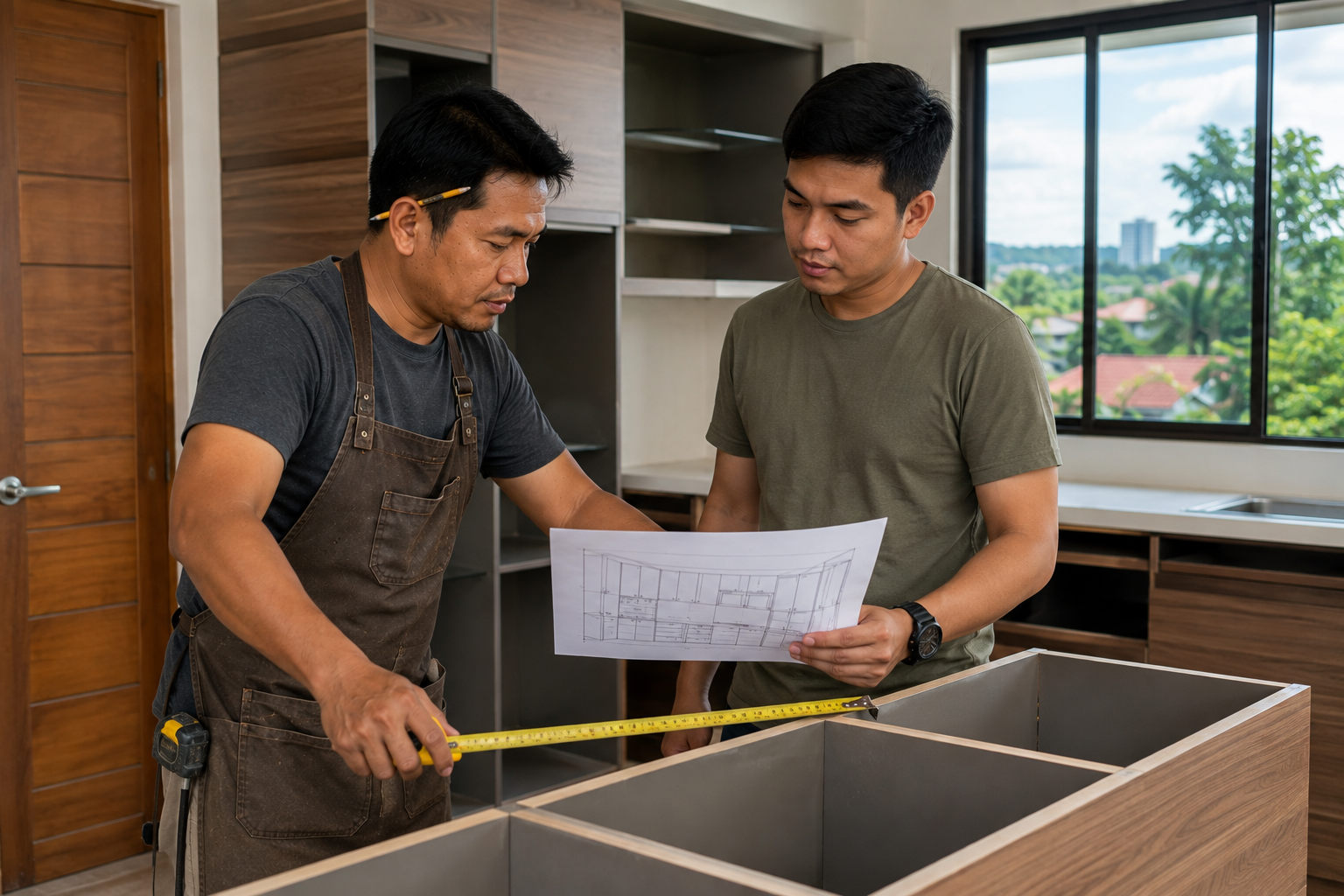
    Search Hub Homepage

  • How to Find a Carpenter in Davao City: Services, Costs & Hiring Tips

    How to Find a Carpenter in Davao City: Services, Costs & Hiring Tips

    Finding the right carpenter in Davao City can make a major difference in the quality, cost, and durability of a home improvement or construction project.

    Whether you need custom cabinets, a built-in wardrobe, wooden doors, furniture, shelving, repairs, or other woodwork, choosing the right professional requires more than searching for the lowest price.

    Davao City has a wide range of residential, commercial, renovation, furniture, and construction projects. That means carpenters may specialize in very different types of work.

    One carpenter may focus on cabinets and custom furniture.

    Another may specialize in construction and structural woodwork.

    Another may primarily handle repairs and small home improvement projects.

    The key is to find someone whose experience matches your specific project.

    This guide explains how to find and compare carpenters in Davao City, what services they may offer, what questions to ask, and how to avoid common hiring mistakes.


    What Does a Carpenter in Davao City Do?

    Carpenters can perform a wide variety of woodworking and installation services.

    Depending on their specialization, a local carpenter may offer:

    • Custom cabinets
    • Kitchen cabinets
    • Built-in wardrobes
    • Wooden doors
    • Shelves
    • Custom furniture
    • Tables
    • Beds
    • Desks
    • TV cabinets
    • Furniture repairs
    • Wood restoration
    • Partitions
    • Interior woodwork
    • Home renovations
    • Installation services

    Not every carpenter offers all of these services.

    Before contacting a provider, identify the exact type of work you need.


    1. Identify Your Carpentry Project

    Before searching for a carpenter, define the project as clearly as possible.

    For example, instead of searching only for:

    carpenter Davao City

    you may get better results with:

    custom cabinet carpenter Davao City

    or:

    furniture carpenter Davao City

    or:

    wooden door carpenter Davao City

    Specific searches help narrow the results to professionals who are more likely to handle your project.


    2. Custom Cabinet Carpenters in Davao City

    Custom cabinets are one of the most common reasons homeowners look for carpentry services.

    Projects can include:

    • Kitchen cabinets
    • Bedroom wardrobes
    • Bathroom cabinets
    • Pantry cabinets
    • TV storage
    • Home-office cabinets
    • Built-in shelving

    Custom cabinets can be designed around the exact dimensions of your room.

    This can be especially useful when dealing with:

    • Uneven walls
    • Small spaces
    • Corners
    • Low ceilings
    • Existing plumbing
    • Electrical outlets
    • Appliances

    When hiring a cabinet carpenter, ask for photographs of previous cabinet projects.

    For more information about choosing a cabinet specialist, read:

    How to Find a Custom Cabinet Carpenter in the Philippines


    3. Kitchen Cabinet Carpenters

    Kitchen cabinetry requires more planning than simply building boxes and doors.

    A carpenter may need to work around:

    • Sinks
    • Plumbing
    • Electrical outlets
    • Refrigerators
    • Ovens
    • Cooktops
    • Range hoods
    • Countertops
    • Kitchen appliances

    Ask whether the carpenter has previously completed kitchen projects.

    Important questions include:

    • What material will be used?
    • What thickness?
    • What hardware?
    • Are drawer slides included?
    • Is finishing included?
    • Is delivery included?
    • Is installation included?

    A good kitchen cabinet project should be planned around how the kitchen will actually be used.


    4. Built-In Wardrobes

    Another common carpentry project is a built-in wardrobe.

    A custom wardrobe can include:

    • Hanging space
    • Shelves
    • Drawers
    • Shoe storage
    • Overhead compartments
    • Sliding doors
    • Hinged doors

    Because the wardrobe is designed around the room, accurate measurements are extremely important.

    Ask the carpenter to perform or confirm final measurements before materials are cut.


    5. Custom Furniture

    Some Davao City carpenters also build custom furniture.

    Examples include:

    • Dining tables
    • Coffee tables
    • Beds
    • Desks
    • Benches
    • Bookshelves
    • TV consoles
    • Storage furniture

    If furniture is your primary project, ask specifically for examples of completed furniture.

    A carpenter with extensive construction experience isn’t necessarily the same as a furniture specialist.

    For more information about the distinction, read:

    Carpenter vs Furniture Maker: What’s the Difference?


    6. Wooden Doors

    Carpenters can also build, install, repair, or modify wooden doors.

    A door project may include:

    • Door slab
    • Door frame
    • Hinges
    • Handles
    • Locks
    • Trimming
    • Installation
    • Finishing

    Ask whether the quotation includes both fabrication and installation.

    You should also confirm whether painting, staining, or varnishing is included.


    7. Furniture Repair

    You don’t necessarily need a new piece of furniture.

    A carpenter may be able to repair:

    • Broken chairs
    • Loose tables
    • Damaged cabinets
    • Broken drawers
    • Wooden doors
    • Shelves
    • Bed frames

    For smaller repairs, ask whether the carpenter charges by the project or by labor time.


    8. Home Renovation Carpentry

    Carpenters are often involved in larger renovation projects.

    They may construct or install:

    • Partitions
    • Cabinets
    • Shelving
    • Doors
    • Ceiling woodwork
    • Decorative panels
    • Built-in storage
    • Other interior woodwork

    If your project involves several trades, such as plumbing, electrical, painting, and carpentry, determine who will coordinate the different workers.


    How to Search for a Carpenter in Davao City

    Use specific searches based on your project.

    Examples include:

    • carpenter Davao City
    • carpenter near me Davao City
    • carpentry services Davao City
    • custom cabinet carpenter Davao
    • kitchen cabinet carpenter Davao
    • furniture maker Davao City
    • custom furniture Davao
    • wooden door carpenter Davao
    • furniture repair Davao City

    You can also use local business directories to find businesses by service and location.

    Browse Search Hub Local Business Services


    Check the Carpenter’s Location

    Davao City covers a large geographic area.

    Before hiring, confirm:

    • Where the carpenter is based
    • Whether they serve your barangay
    • Whether site visits are available
    • Whether delivery is included
    • Whether installation is available
    • Whether transportation costs apply

    A carpenter may be excellent but charge additional transportation costs if your project is far from their workshop.


    Ask About Previous Projects

    One of the best ways to evaluate a carpenter is to see their previous work.

    Ask:

    “Can you show me projects similar to mine?”

    Look at:

    • Cabinet alignment
    • Door gaps
    • Drawer operation
    • Surface finishing
    • Edges
    • Joints
    • Hardware
    • Overall workmanship

    Don’t judge a carpenter only by photographs of their most impressive project.

    Look for consistency across several projects.


    Ask About Materials

    Material selection can have a major impact on the final project.

    Common cabinet and furniture materials include:

    • Plywood
    • MDF
    • Particle board
    • Solid wood
    • Veneer
    • Laminated boards

    Ask the carpenter:

    “Why do you recommend this material for my project?”

    A professional should be able to explain the advantages and limitations.

    For a detailed comparison:

    Plywood vs MDF vs Particle Board for Cabinets


    Don’t Forget Material Thickness

    A quotation that says:

    “Plywood cabinet”

    isn’t detailed enough.

    Ask:

    • What grade?
    • What thickness?
    • What material for the doors?
    • What material for the shelves?
    • What material for the cabinet back?

    Material thickness can affect both performance and price.


    Check the Hardware

    Hardware can make a significant difference in how cabinets and furniture operate.

    Ask about:

    • Hinges
    • Drawer slides
    • Handles
    • Locks
    • Soft-close mechanisms
    • Pull-out systems

    If two quotations have very different prices, hardware may be one reason.

    Make sure you’re comparing equivalent specifications.


    Get a Detailed Quotation

    Before hiring, request a written quotation.

    It should ideally identify:

    • Project scope
    • Dimensions
    • Materials
    • Labor
    • Hardware
    • Finishing
    • Delivery
    • Installation
    • Timeline
    • Payment terms

    Avoid relying solely on a verbal price.

    For a complete guide:

    How to Compare Carpenter Quotations


    Don’t Automatically Choose the Cheapest Carpenter

    Price is important, but it isn’t the only consideration.

    Suppose you receive:

    ₱60,000

    ₱75,000

    ₱90,000

    The ₱60,000 quotation may look attractive.

    But perhaps it uses:

    • Lower-cost materials
    • Standard hardware
    • Basic finishing
    • No installation
    • No delivery

    The ₱90,000 quotation may include premium materials, better hardware, delivery, installation, and a longer workmanship guarantee.

    Compare the scope, not just the total.


    Ask About Delivery and Installation

    For large furniture and cabinets, delivery can be a significant part of the project.

    Ask:

    • Is delivery included?
    • Is carrying included?
    • Is assembly included?
    • Is installation included?
    • Are wall mounting and adjustments included?

    Also ask whether there are additional charges for difficult access.


    Ask About the Timeline

    Before making a deposit, ask:

    “When can you start?”

    and:

    “When should the project be completed?”

    Custom carpentry may involve:

    1. Measurement
    2. Design
    3. Quotation
    4. Material purchasing
    5. Fabrication
    6. Finishing
    7. Delivery
    8. Installation

    Each stage takes time.

    A realistic timeline is better than an overly optimistic promise.


    Understand Payment Terms

    Before paying, clarify:

    • Deposit amount
    • Progress payments
    • Final payment
    • Payment milestones
    • Additional work charges

    For a large project, consider documenting the payment schedule.

    Also ask what happens if the design changes after fabrication begins.


    Be Careful With Design Changes

    Changes can affect:

    • Materials
    • Labor
    • Hardware
    • Timeline
    • Finishing

    For example, adding two drawers after production begins could require additional materials and labor.

    Ask for the additional cost before approving the change.


    Consider Local Recommendations

    Personal recommendations can be useful when looking for a carpenter.

    Ask:

    • Friends
    • Relatives
    • Neighbors
    • Property managers
    • Contractors
    • Interior designers

    However, even a recommended carpenter should still be evaluated based on your specific project.


    Check Online Reviews

    Online reviews can provide additional information about:

    • Communication
    • Reliability
    • Quality
    • Timeliness
    • Pricing
    • Customer service

    Don’t look only at the star rating.

    Read the actual comments.

    Pay attention to repeated complaints or repeated praise.


    Watch for Red Flags

    Be cautious if a carpenter:

    • Refuses to provide a written quotation
    • Cannot explain materials
    • Has no relevant portfolio
    • Changes prices without explanation
    • Demands unclear payments
    • Cannot provide a reasonable timeline
    • Is difficult to contact
    • Avoids discussing installation
    • Doesn’t confirm measurements

    These issues don’t automatically mean the carpenter is bad, but they deserve attention.


    What Does a Carpenter Cost in Davao City?

    There is no single price for carpentry services in Davao City.

    The cost depends on:

    • Project size
    • Materials
    • Labor
    • Design
    • Hardware
    • Finishing
    • Delivery
    • Installation
    • Location
    • Complexity

    A small furniture repair is obviously different from a complete kitchen cabinet installation.

    Rather than relying on one generic price, request a project-specific quotation.

    See:

    How Much Does a Carpenter Cost in the Philippines?


    How to Get Better Carpenter Quotations

    Before contacting a carpenter, prepare as much information as possible.

    Include:

    Project type

    Example:

    Custom kitchen cabinets

    Approximate dimensions

    Example:

    Approximately 12 feet of cabinet space

    Material preference

    Example:

    Plywood with laminate finish

    Hardware

    Example:

    Soft-close hinges and drawer slides

    Installation

    Example:

    Delivery and installation required

    Timeline

    Example:

    Preferably within four weeks

    This makes it much easier for the carpenter to prepare a useful quotation.


    Example Carpenter Request

    You could send a carpenter a message like:

    Hello, I need custom kitchen cabinets in Davao City. The total cabinet area is approximately 12 feet. I am considering plywood construction with a laminated finish, six drawers, soft-close hinges, delivery, and installation. Could you provide a detailed quotation including materials, labor, hardware, finishing, delivery, installation, and estimated completion time?

    This is much more useful than:

    “How much for kitchen cabinets?”


    What to Bring to the Carpenter

    If you’re visiting a workshop, bring:

    • Measurements
    • Photos of the room
    • Inspiration photos
    • Basic layout
    • Appliance dimensions
    • Preferred colors
    • Material preferences

    If you have architectural or interior design drawings, provide those as well.


    Choosing Between a Carpenter and Furniture Maker

    Sometimes the right professional isn’t necessarily someone who calls themselves a carpenter.

    For example:

    Built-in cabinets: Carpenter or cabinet maker

    Custom dining table: Furniture maker or carpenter with furniture experience

    Wooden door: Carpenter

    Furniture repair: Carpenter or furniture restoration specialist

    Large renovation: Carpenter working with a renovation team

    Focus on the professional’s actual experience.


    Finding a Carpenter Near Davao City Neighborhoods

    When searching locally, you can also include your specific area.

    For example:

    • carpenter Buhangin Davao City
    • carpenter Toril Davao City
    • carpenter Talomo Davao City
    • carpenter Matina Davao City
    • carpenter Bajada Davao City
    • carpenter Lanang Davao City

    This can help identify providers who are closer to your project.

    However, don’t automatically choose the closest provider.

    Quality and relevant experience still matter.


    How Search Hub Can Help

    Search Hub is designed to make it easier to discover businesses and services by category and location.

    For someone searching for a carpenter in Davao City, the journey can be:

    Search for information → Identify the service → Compare providers → Contact a local business

    Start with:

    Search Hub Local Business Services

    You can also return to the:

    Search Hub homepage

    As the directory grows, location-specific business listings can make it easier for homeowners to find relevant local service providers.


    Frequently Asked Questions

    How do I find a reliable carpenter in Davao City?

    Search specifically for the type of service you need, check previous work, request detailed quotations, compare materials and workmanship, and confirm the timeline and installation arrangements.

    How much does a carpenter charge in Davao City?

    There is no single standard price. The cost depends on the project, materials, labor, design, hardware, finishing, delivery, and installation.

    Should I get multiple quotations?

    For larger projects, getting two or three detailed quotations can help you understand the market and compare specifications.

    What should I ask a Davao City carpenter?

    Ask about experience, previous projects, materials, hardware, finishing, labor, delivery, installation, timeline, payment terms, and additional charges.

    Can a carpenter build custom cabinets?

    Yes. Many carpenters specialize in custom cabinetry, although some focus more on construction, repairs, or other woodwork.

    How do I know if a carpenter’s price is reasonable?

    Compare multiple quotations based on the same specifications rather than comparing only the final price.

    Should I pay a deposit?

    Payment arrangements vary. Before paying, make sure the project scope, materials, price, and payment schedule are clearly documented.


    Final Thoughts

    Finding a carpenter in Davao City doesn’t have to mean choosing the first person who appears in a search result.

    Start by defining exactly what you need.

    Then look for a professional with relevant experience.

    Check previous projects.

    Ask about materials and hardware.

    Request a detailed quotation.

    Compare at least a few providers for larger projects.

    And confirm delivery, installation, payment terms, and timelines before work begins.

    The cheapest carpenter isn’t necessarily the best choice, and the most expensive isn’t automatically the best either.

    The better choice is the professional who provides the right combination of experience, workmanship, materials, communication, price, and reliability for your particular project.

    If you’re comparing carpenters, start with Reliable Carpenter Near You.

    For cabinet material information, read Plywood vs MDF vs Particle Board for Cabinets.

    For quotation guidance, see How to Compare Carpenter Quotations.

    For pricing information, read How Much Does a Carpenter Cost in the Philippines?.

    And when you’re ready to discover local providers, visit Search Hub Local Business Services or return to the Search Hub homepage.

  • How to Compare Carpenter Quotations: A Homeowner’s Guide

    How to Compare Carpenter Quotations: A Homeowner’s Guide

    Getting several quotations is one of the smartest things you can do before hiring a carpenter.

    Whether you’re planning custom cabinets, a built-in wardrobe, furniture, wooden doors, shelving, repairs, or a larger renovation project, comparing quotations can help you understand what you’re actually paying for.

    However, comparing carpenter quotations isn’t as simple as putting three prices beside each other and choosing the lowest one.

    One carpenter might quote ₱50,000 while another quotes ₱70,000 for what appears to be the same project.

    At first glance, the lower quotation may seem like the obvious choice.

    But what if the cheaper quotation uses a different material?

    What if it doesn’t include installation?

    What if the hardware is lower quality?

    What if finishing isn’t included?

    What if delivery is charged separately?

    This is why you need to compare the entire project scope, not just the final price.

    This guide explains how to compare carpenter quotations in the Philippines and what you should check before accepting an estimate.


    Why You Should Get More Than One Carpenter Quotation

    Getting multiple quotations gives you a better understanding of the potential cost of your project.

    It can also reveal differences in:

    • Materials
    • Labor
    • Hardware
    • Finishing
    • Design
    • Construction methods
    • Delivery
    • Installation
    • Project timelines

    For a simple repair, one quotation may be enough if you already know and trust the carpenter.

    For a large custom project, however, comparing several providers can be extremely useful.

    A good target is to obtain two or three detailed quotations based on the same project specifications.


    Start With the Same Project Specifications

    One of the biggest mistakes homeowners make is asking different carpenters for quotations without giving them the same information.

    For example, you might tell Carpenter A:

    “I need kitchen cabinets.”

    But tell Carpenter B:

    “I need 12 feet of kitchen cabinets using plywood, soft-close hinges, six drawers, laminated finish, delivery, and installation.”

    The two quotations won’t be comparable.

    Instead, give every carpenter the same basic information.

    Include:

    • Approximate dimensions
    • Type of project
    • Preferred material
    • Number of cabinets or furniture pieces
    • Hardware requirements
    • Finish
    • Delivery requirements
    • Installation requirements
    • Desired timeline

    The more consistent your specifications are, the more useful the comparison becomes.


    What Should Be Included in a Carpenter Quotation?

    A detailed carpenter quotation should ideally identify several major cost components.

    These can include:

    1. Labor
    2. Materials
    3. Hardware
    4. Finishing
    5. Delivery
    6. Installation
    7. Design
    8. Additional work
    9. Timeline
    10. Payment terms

    Not every project requires every category.

    The important thing is that you understand what is included.


    1. Compare Labor Costs

    Labor is one of the largest components of many carpentry projects.

    But labor can be calculated in different ways.

    A carpenter may charge:

    • A fixed project price
    • A daily labor rate
    • A per-piece rate
    • A per-square-meter rate
    • A combination of labor and materials

    Ask how the carpenter calculated the labor component.

    For a fixed-price project, ask:

    “Does this labor price cover the complete project?”

    For daily labor, ask:

    “How many days do you estimate the project will take?”

    A low daily rate isn’t necessarily cheaper if the project takes significantly longer.


    2. Compare Materials

    Material specifications are one of the most important parts of a carpenter quotation.

    Don’t accept a quotation that simply says:

    “Wood materials — ₱XX,XXX”

    Ask exactly what will be used.

    For cabinets, materials may include:

    • Plywood
    • MDF
    • Particle board
    • Solid wood
    • Laminated boards
    • Veneer

    For a detailed comparison, read:

    Plywood vs MDF vs Particle Board for Cabinets


    Ask About Material Thickness

    Material type alone isn’t enough.

    Ask about thickness.

    For example:

    “What thickness of plywood will you use for the cabinet sides?”

    Also ask about:

    • Shelves
    • Doors
    • Drawer components
    • Cabinet backs

    Different components may use different thicknesses.

    If one carpenter quotes a higher price because they are using thicker or higher-grade material, the difference may be justified.


    3. Compare Hardware

    Hardware can have a significant effect on both price and usability.

    Depending on the project, hardware can include:

    • Hinges
    • Drawer slides
    • Handles
    • Knobs
    • Locks
    • Brackets
    • Pull-out systems
    • Soft-close mechanisms

    Don’t assume that “hardware included” means the same thing in every quotation.

    Ask for the actual specifications.

    For example:

    Quotation A: Standard hinges

    Quotation B: Soft-close hinges

    Those aren’t necessarily equivalent products.


    4. Compare the Finishing

    Finishing can make a substantial difference in both appearance and price.

    Possible finishes include:

    • Paint
    • Varnish
    • Stain
    • Clear coat
    • Laminate
    • Veneer
    • Sealer

    Ask whether the quotation includes:

    • Sanding
    • Surface preparation
    • Primer
    • Paint
    • Final coat
    • Sealing
    • Touch-ups

    A quotation that looks cheaper may simply exclude finishing.


    5. Check Delivery Costs

    Delivery is often overlooked.

    Large cabinets and furniture may require a vehicle and several people to move them.

    Ask:

    “Is delivery included?”

    Also ask:

    • Where will delivery start?
    • Is transportation included?
    • Are carrying charges included?
    • Are stairs included?
    • Is there an additional charge for difficult access?

    For condominium projects, delivery may also have building-specific requirements.


    6. Check Installation Costs

    Another common source of confusion is installation.

    One quotation might include installation while another doesn’t.

    For example:

    Carpenter A: ₱80,000 including installation

    Carpenter B: ₱70,000 + ₱15,000 installation

    The second quotation is actually more expensive.

    Always identify whether the quoted price includes:

    • Assembly
    • Wall mounting
    • Cabinet leveling
    • Hardware adjustment
    • Final fitting
    • Cleanup

    7. Compare Project Timelines

    Time is another important part of a quotation.

    Ask:

    “When can you start?”

    and:

    “When do you expect the project to be completed?”

    The quotation should ideally provide an estimated timeline.

    For custom cabinetry, the process may involve:

    1. Measurement
    2. Design
    3. Material purchasing
    4. Fabrication
    5. Finishing
    6. Delivery
    7. Installation

    A carpenter who promises an extremely short timeline should be able to explain how they plan to achieve it.


    8. Compare Payment Terms

    Payment terms should be clear before work begins.

    Ask:

    • How much is the deposit?
    • When are progress payments due?
    • When is the final payment due?
    • What triggers each payment?
    • How are additional costs handled?

    For larger projects, you may want payments to correspond to identifiable milestones.

    For example:

    Deposit → Materials

    Progress payment → Fabrication

    Final payment → Installation/completion

    The exact arrangement should be agreed upon by both parties.


    9. Look for Hidden Costs

    A quotation can appear inexpensive because important items are excluded.

    Potential additional costs may include:

    • Delivery
    • Installation
    • Additional materials
    • Hardware upgrades
    • Finishing
    • Site preparation
    • Removal of old cabinets
    • Electrical adjustments
    • Plumbing adjustments
    • Design changes

    Ask:

    “Are there any costs that aren’t included in this quotation?”

    This simple question can prevent unpleasant surprises.


    10. Compare the Scope of Work

    The quotation should clearly describe what the carpenter will actually build.

    For example:

    “Kitchen cabinets”

    is vague.

    A better description might specify:

    • Cabinet length
    • Number of base cabinets
    • Number of wall cabinets
    • Number of drawers
    • Material
    • Hardware
    • Finish
    • Installation

    The more specific the scope, the easier it is to compare quotations.


    Use a Carpenter Quotation Comparison Table

    A simple table can make the differences obvious.

    Item Carpenter A Carpenter B Carpenter C
    Labor ₱30,000 ₱35,000 ₱28,000
    Materials ₱45,000 ₱50,000 ₱40,000
    Hardware Included Premium Standard
    Finishing Included Included Extra
    Delivery Included Extra Included
    Installation Included Included Extra
    Estimated timeline 3 weeks 4 weeks 3 weeks
    Total ₱75,000 ₱85,000+ ₱68,000+

    The table immediately shows why the lowest headline price may not actually be the cheapest complete option.


    Don’t Compare Price Alone

    This is probably the most important rule.

    A ₱60,000 quotation isn’t necessarily better than a ₱75,000 quotation.

    The ₱75,000 quotation may include:

    • Better material
    • Better hardware
    • Better finishing
    • Delivery
    • Installation
    • Longer workmanship coverage

    The lower quotation may not include these things.

    Instead of asking:

    “Who is cheapest?”

    ask:

    “Which quotation gives me the best combination of quality, scope, and value?”


    Why Extremely Cheap Quotations Can Be Risky

    An unusually low quotation doesn’t automatically mean the carpenter is unreliable.

    There could be a legitimate reason.

    Perhaps the carpenter:

    • Has lower overhead
    • Works from a small workshop
    • Has direct access to materials
    • Has a simpler construction method
    • Is offering a promotional rate

    However, a very large price difference should make you ask questions.

    For example:

    “Can you explain why your quotation is significantly lower than the others?”

    Compare the specifications before deciding.


    Check the Carpenter’s Previous Work

    Price isn’t the only indicator of quality.

    Ask for examples of completed projects.

    If you’re building kitchen cabinets, ask to see kitchens.

    If you’re ordering furniture, ask to see furniture.

    Look at:

    • Alignment
    • Edges
    • Joints
    • Finishing
    • Hardware
    • Door operation
    • Drawer operation
    • Overall workmanship

    For a general hiring checklist, see:

    Reliable Carpenter Near You


    Ask About Materials You Don’t Understand

    You don’t need to become a woodworking expert before hiring a carpenter.

    If you don’t understand a material or construction method, ask.

    For example:

    “Why are you recommending MDF instead of plywood?”

    or:

    “Why are the cabinet doors a different material from the cabinet boxes?”

    A professional should be able to explain the reasoning in understandable terms.


    Check Whether the Carpenter Handles Design

    Some carpenters work from customer-provided drawings.

    Others can design the project themselves.

    Ask:

    “Do you provide the design, or do I need to provide the drawings?”

    If design is included, find out whether revisions are included.

    For custom cabinets, design changes can affect both material requirements and labor.


    Watch for Design Change Charges

    Changes after fabrication begins can become expensive.

    For example, changing:

    • Cabinet dimensions
    • Number of drawers
    • Hardware
    • Material
    • Finish
    • Layout

    may require additional work.

    Before approving a change, ask for the additional cost in writing.


    Ask About Material Price Changes

    For longer projects, material prices can potentially change.

    Ask:

    “Is this quotation fixed until completion?”

    If it isn’t fixed, ask how price changes will be calculated.

    This is particularly important for larger projects where materials represent a substantial part of the budget.


    Check Whether Old Furniture Removal Is Included

    If you’re replacing existing cabinets or furniture, ask who will remove the old items.

    Potential services include:

    • Dismantling
    • Carrying
    • Disposal
    • Transportation

    These may not be included in the new cabinet quotation.


    Compare the Timeline With Your Needs

    Sometimes paying slightly more for a reliable timeline is worthwhile.

    For example, if you’re renovating a kitchen, delays can affect:

    • Appliance installation
    • Plumbing
    • Electrical work
    • Countertops
    • Moving back into the space

    Don’t choose a carpenter based on price alone if the project deadline is important.


    Get Everything in Writing

    Once you’ve chosen a carpenter, make sure the important details are documented.

    At minimum, record:

    • Project description
    • Dimensions
    • Materials
    • Hardware
    • Finish
    • Total price
    • Payment schedule
    • Timeline
    • Delivery
    • Installation
    • Additional work terms

    Written documentation protects both sides from misunderstandings.


    What Makes a Good Carpenter Quotation?

    A good quotation should be:

    Clear

    You should understand what you’re paying for.

    Detailed

    Materials and services should be identified.

    Realistic

    The price and timeline should make sense for the project.

    Comparable

    The specifications should allow you to compare it with other quotations.

    Transparent

    Additional costs should be explained.


    Red Flags in Carpenter Quotations

    Be careful if a quotation:

    • Has no material specifications
    • Has no project dimensions
    • Doesn’t identify hardware
    • Doesn’t mention installation
    • Has unclear payment terms
    • Has unexplained additional charges
    • Changes frequently without documentation
    • Is dramatically cheaper without explanation
    • Requires a large payment without clear milestones

    Again, any one issue doesn’t necessarily mean the carpenter is unreliable.

    Look at the overall picture.


    Questions to Ask Before Accepting a Quotation

    Before you say yes, ask:

    1. What exactly is included?
    2. What material will be used?
    3. What thickness will be used?
    4. What hardware is included?
    5. Is finishing included?
    6. Is delivery included?
    7. Is installation included?
    8. How long will the project take?
    9. When can you start?
    10. What is the payment schedule?
    11. Are design changes extra?
    12. Can the price change?
    13. What happens if there is a delay?
    14. Do you provide workmanship guarantees?

    The answers should be clear before work starts.


    Example: Comparing Kitchen Cabinet Quotations

    Imagine you need a custom kitchen cabinet project.

    Carpenter A

    ₱95,000

    Includes:

    • Plywood
    • Standard hardware
    • Laminate finish
    • Delivery
    • Installation

    Carpenter B

    ₱110,000

    Includes:

    • Higher-grade plywood
    • Soft-close hardware
    • Premium laminate
    • Delivery
    • Installation
    • More detailed internal storage

    Carpenter C

    ₱80,000

    Includes:

    • MDF
    • Basic hardware
    • Basic finish

    But:

    • Delivery extra
    • Installation extra

    The quotations aren’t directly equivalent.

    Once you compare the specifications, the price differences become easier to understand.


    What If One Carpenter Won’t Give a Detailed Quote?

    You can ask them to provide one.

    Say:

    “Could you please break down the quotation into materials, labor, hardware, finishing, delivery, and installation?”

    If they still refuse to explain what you’re paying for, consider getting another quotation.

    Transparency is particularly important for expensive custom projects.


    How Search Hub Can Help You Find Local Carpenters

    Once you understand how to compare quotations, the next step is finding providers.

    Search Hub’s Local Business Services directory can serve as a starting point for discovering local businesses and service providers.

    You can search based on the service and location you need.

    For example:

    • Carpenter
    • Cabinet maker
    • Furniture maker
    • Custom furniture
    • Home improvement

    The goal is to make it easier to move from:

    Search → Compare → Contact → Request quotation

    rather than choosing the first provider you find.


    Comparing Carpenter Quotations in Davao City

    If you’re looking for a carpenter in Davao City, try to compare providers based on the same project specifications.

    For example:

    “I need 12 feet of kitchen cabinets, plywood construction, six drawers, soft-close hardware, laminated finish, delivery and installation.”

    Giving each carpenter the same information makes the resulting quotations much more useful.


    Comparing Carpenter Quotations in General Santos City

    The same principle applies in General Santos City.

    Don’t simply ask:

    “How much for a cabinet?”

    Instead, provide:

    • Dimensions
    • Material
    • Design
    • Hardware
    • Finish
    • Delivery
    • Installation

    Then compare the responses.

    You can also use Search Hub Local Business Services to discover local providers.


    How Much Should You Pay for a Carpenter?

    There isn’t a single price that applies to every carpentry project.

    Costs depend on:

    • Location
    • Project size
    • Materials
    • Labor
    • Design
    • Hardware
    • Finishing
    • Delivery
    • Installation

    Instead of relying on one generic price, obtain project-specific quotations.

    For additional pricing information, see:

    How Much Does a Carpenter Cost in the Philippines?


    Frequently Asked Questions

    How many carpenter quotations should I get?

    For a significant project, getting two or three detailed quotations can provide a useful comparison.

    Should I always choose the cheapest quotation?

    No. Compare the complete scope, materials, hardware, finishing, delivery, installation, and timeline.

    What should a carpenter quotation include?

    Ideally, it should identify the project scope, materials, labor, hardware, finishing, delivery, installation, timeline, and payment terms.

    Should I negotiate a carpenter’s quotation?

    You can discuss the quotation, but don’t focus only on lowering the price. Ask whether there are ways to adjust the design, materials, or scope while maintaining acceptable quality.

    Why are two carpenter quotations so different?

    Differences can come from materials, hardware, labor, finishing, design, delivery, installation, experience, overhead, or project scope.

    Should I pay a large deposit?

    Payment terms vary by project. Before paying, make sure the scope, materials, timeline, and payment milestones are clearly documented.

    What if the carpenter changes the price later?

    Ask why the price changed and request the revised scope and cost in writing before approving additional work.


    Final Thoughts

    Learning how to compare carpenter quotations can save you from choosing a provider based solely on a tempting low price.

    The best quotation isn’t necessarily the cheapest.

    Instead, look at the complete package:

    Materials

    Labor

    Hardware

    Finishing

    Delivery

    Installation

    Timeline

    Payment terms

    Workmanship

    When all of these factors are compared using the same project specifications, you can make a much more informed decision.

    Before hiring, review the carpenter’s previous work and make sure you understand exactly what is included.

    For a broader hiring checklist, read Reliable Carpenter Near You.

    For material selection, read Plywood vs MDF vs Particle Board for Cabinets.

    For pricing information, see How Much Does a Carpenter Cost in the Philippines?.

    When you’re ready to find local service providers, browse Search Hub Local Business Services.

    You can also visit the Search Hub homepage for more local business guides.

  • Plywood vs MDF vs Particle Board for Cabinets: Which Is Best?

    Plywood vs MDF vs Particle Board for Cabinets: Which Is Best?

    Choosing the right material is one of the most important decisions when building custom cabinets.

    The cabinet design may look perfect, but the materials used for the cabinet boxes, doors, shelves, and other components can have a major effect on the finished product.

    Three materials commonly considered for cabinetry and furniture are plywood, MDF, and particle board.

    Each has advantages and limitations.

    Plywood is often selected when strength and structural performance are important. MDF provides a smooth, consistent surface that can work particularly well for painted applications. Particle board can provide a practical option for projects where controlling costs is important.

    But there isn’t one material that is automatically the best for every cabinet.

    The right choice depends on where the cabinet will be installed, how it will be used, moisture exposure, desired appearance, hardware, construction method, finishing, and budget.

    If you’re planning custom cabinets in the Philippines, understanding these differences can help you have a more productive conversation with your carpenter or cabinet maker.


    What Is Plywood?

    Plywood is an engineered wood product made by bonding multiple layers, or veneers, together.

    The layers are generally arranged with their wood grain oriented in different directions.

    This construction gives plywood useful structural characteristics and makes it a common choice for furniture, cabinetry, construction, and other applications.

    However, not all plywood is the same.

    Different grades, thicknesses, core constructions, and finishes can have very different characteristics.

    That’s why simply asking for “plywood cabinets” isn’t enough.

    You should also ask:

    • What grade?
    • What thickness?
    • What type?
    • Where will it be used?
    • What finish will be applied?

    Advantages of Plywood for Cabinets

    Plywood can offer several advantages for cabinetry.

    Strength

    Quality plywood can provide good structural performance for cabinet boxes, shelves, and furniture components.

    The actual performance depends on the plywood grade, thickness, construction, and how the cabinet is assembled.

    Screw Holding

    Plywood can provide useful screw-holding performance when the appropriate material and construction methods are used.

    This can be important for cabinet hardware and repeated assembly or adjustment.

    Layered Construction

    The cross-layer construction gives plywood characteristics that differ from solid wood and other sheet materials.

    Appearance

    Depending on the type of plywood and finish, the exposed edges and surfaces can contribute to a natural wood appearance.

    Versatility

    Plywood can be used for many different cabinetry and furniture applications.


    Limitations of Plywood

    Plywood isn’t automatically perfect.

    Potential disadvantages can include:

    • Higher cost for some grades
    • Surface differences between grades
    • Visible edge layers
    • More finishing requirements for certain applications
    • Quality variation between products

    A high-quality plywood cabinet and a low-quality plywood cabinet can be very different products.

    This is why material specifications matter.


    What Is MDF?

    MDF stands for medium-density fiberboard.

    It is manufactured from refined wood fibers combined with resin and compressed into panels.

    One of MDF’s most noticeable characteristics is its relatively smooth and uniform surface.

    This makes it popular for applications where a consistent surface is important.

    MDF is commonly used in:

    • Cabinet doors
    • Furniture
    • Shelving
    • Interior panels
    • Painted cabinetry
    • Decorative components

    Advantages of MDF for Cabinets

    Smooth Surface

    MDF provides a smooth surface that can work well for painted cabinet doors and furniture.

    Consistency

    Because it is manufactured from wood fibers rather than layers of veneer, its surface is generally uniform.

    Good for Painted Finishes

    MDF can be particularly useful when the design calls for a smooth painted appearance.

    Easy to Shape

    Depending on the equipment and design, MDF can be routed or shaped for certain decorative profiles.


    Limitations of MDF

    MDF also has limitations.

    These can include:

    • Greater weight than some alternatives
    • Sensitivity to prolonged moisture exposure
    • Edge damage if improperly handled
    • Material-specific fastening considerations

    The environment where the cabinet will be installed matters.

    A cabinet in a dry interior bedroom has different requirements from one exposed to repeated moisture.


    What Is Particle Board?

    Particle board is an engineered wood panel made from wood particles that are bonded and compressed.

    It is widely used in furniture and cabinetry, particularly in cost-conscious applications.

    Like plywood and MDF, particle board comes in different grades and specifications.

    The quality and suitability depend on:

    • Density
    • Thickness
    • Surface treatment
    • Edge protection
    • Moisture exposure
    • Hardware
    • Construction method

    Advantages of Particle Board

    Cost

    Particle board can be an economical choice for certain cabinet and furniture projects.

    Uniform Panels

    Manufactured panels provide consistent dimensions and surfaces.

    Laminated Applications

    Particle board is commonly used with finished surfaces such as laminates.

    Furniture Applications

    It can work well for certain interior furniture and cabinetry when properly specified and constructed.


    Limitations of Particle Board

    Potential limitations include:

    • Lower performance in some applications compared with higher-grade alternatives
    • Sensitivity to moisture
    • Edge durability concerns
    • Hardware fastening considerations
    • Variation between grades

    This doesn’t mean particle board is automatically a poor material.

    It means you need to understand where and how it will be used.


    Plywood vs MDF vs Particle Board

    Here’s a simplified comparison:

    Factor Plywood MDF Particle Board
    Construction Layered wood veneers Compressed wood fibers Compressed wood particles
    Surface Depends on grade Smooth and uniform Depends on finish
    Painted finish Good with preparation Very good Depends on surface
    Structural use Often suitable Application-dependent Application-dependent
    Weight Varies Generally relatively heavy Varies
    Moisture Grade-dependent Needs protection Needs protection
    Cost Varies Often mid-range Often budget-oriented
    Cabinet use Very common Common Common
    Furniture use Very common Common Common

    This table is only a starting point.

    The specific product specification matters.


    Which Material Is Strongest?

    There isn’t a single answer that applies to every product.

    Plywood is often selected when structural performance is a priority, but the strength of a cabinet depends on much more than the sheet material.

    It also depends on:

    • Thickness
    • Cabinet dimensions
    • Joint construction
    • Shelving span
    • Fasteners
    • Back panel
    • Hardware
    • Load
    • Installation

    A well-designed cabinet made from an appropriate material can perform very well.


    Which Material Is Best for Kitchen Cabinets?

    Kitchen cabinets have different requirements from bedroom furniture.

    A kitchen may expose cabinets to:

    • Humidity
    • Water splashes
    • Steam
    • Food spills
    • Frequent cleaning
    • Heavy cookware

    This makes material selection particularly important.

    Ask the carpenter how the proposed material will handle the environment.

    Also consider:

    • Sink cabinet construction
    • Edge protection
    • Cabinet backs
    • Door material
    • Hardware
    • Finishing
    • Ventilation

    The area underneath a kitchen sink deserves particular attention because it may experience more moisture than other cabinet sections.


    Which Material Is Best for Bedroom Wardrobes?

    Bedroom wardrobes are generally exposed to a more controlled indoor environment.

    The priorities may therefore shift toward:

    • Appearance
    • Storage design
    • Weight
    • Door operation
    • Shelving
    • Finish
    • Budget

    MDF, plywood, particle board, or combinations of materials may all be appropriate depending on the design.


    Which Material Is Best for Cabinet Doors?

    Cabinet doors are different from cabinet boxes.

    The material needs to work with:

    • Door size
    • Hinge type
    • Door design
    • Finish
    • Weight
    • Style

    MDF can be attractive for painted doors because of its smooth surface.

    Plywood can work well for certain natural or laminated designs.

    Other materials may also be suitable depending on the design.

    The best option should be evaluated as part of the complete cabinet system.


    Which Material Is Best for Shelves?

    Shelves need to support their expected load without excessive sagging.

    The appropriate material depends on:

    • Shelf length
    • Thickness
    • Load
    • Support spacing
    • Material
    • Cabinet design

    A long shelf carrying heavy kitchen equipment has different requirements from a short bedroom shelf holding folded clothing.

    Don’t select shelf material based only on the cabinet doors.


    What About Moisture?

    Moisture is one of the most important considerations when choosing cabinet materials.

    Areas that may require additional attention include:

    • Kitchens
    • Bathrooms
    • Laundry areas
    • Areas near sinks
    • Outdoor or semi-outdoor spaces

    No cabinet material should simply be assumed to be waterproof.

    Ask your carpenter:

    “How will this material be protected from moisture?”

    Possible considerations include:

    • Proper sealing
    • Edge protection
    • Appropriate finishes
    • Installation away from direct water exposure
    • Suitable material selection

    Good construction and installation are just as important as the panel itself.


    Does Thickness Matter?

    Yes.

    Two cabinets can use the same material while having different performance because the thickness is different.

    When getting a quotation, ask:

    “What thickness will you use for the cabinet sides, shelves, doors, and back?”

    The answer should be clearly documented.

    Different parts of a cabinet may also use different thicknesses depending on the design.


    What About Cabinet Back Panels?

    The cabinet back is easy to overlook.

    However, it can contribute to:

    • Stability
    • Alignment
    • Appearance
    • Protection
    • Installation

    Ask what material and thickness will be used for the back panel.

    Don’t assume it will automatically be the same material as the cabinet sides.


    How Hardware Affects Material Choice

    The cabinet material and hardware need to work together.

    Hardware can include:

    • Hinges
    • Drawer slides
    • Handles
    • Pull-out systems
    • Brackets
    • Locks

    Ask how the hardware will be attached.

    This is particularly important for frequently used drawers and doors.

    A cabinet’s long-term performance depends on the entire system rather than one component.


    Does the Finish Change the Material Decision?

    Yes.

    The desired appearance can influence material choice.

    For example:

    Painted cabinets

    A smooth engineered surface can be desirable.

    Natural wood appearance

    A suitable plywood, veneer, or solid wood option may be considered.

    Laminated cabinets

    Manufactured boards can provide an appropriate substrate depending on the application.

    Discuss the desired appearance before choosing the material.


    Plywood vs MDF for Painted Cabinets

    MDF is often considered for painted applications because of its smooth, uniform surface.

    However, plywood can also be prepared and painted appropriately.

    The decision depends on:

    • Cabinet design
    • Door style
    • Construction
    • Desired appearance
    • Weight
    • Budget
    • Carpenter’s fabrication method

    Don’t assume that one material automatically produces a better finished cabinet.

    The preparation and finishing process also matter.


    MDF vs Particle Board for Cabinets

    Both are manufactured wood products, but they have different structures and characteristics.

    MDF uses refined wood fibers.

    Particle board uses larger wood particles.

    The appropriate choice depends on the specific product and application.

    Ask about:

    • Density
    • Thickness
    • Moisture exposure
    • Surface finish
    • Edge treatment
    • Hardware
    • Expected load

    Avoid choosing purely based on the material name.


    Plywood vs Particle Board

    Plywood is often considered when greater structural performance is needed.

    Particle board can make sense for certain interior furniture and cabinetry where cost efficiency is important.

    Again, the actual product specification and cabinet construction matter.

    A poorly constructed plywood cabinet isn’t automatically better than a well-designed cabinet made from another suitable material.


    Should You Mix Cabinet Materials?

    Yes, depending on the design.

    A cabinet may use different materials for different components.

    For example:

    • One material for cabinet boxes
    • Another for doors
    • Another for backing
    • Different material for shelves
    • Different finish for exposed surfaces

    This can balance:

    • Performance
    • Appearance
    • Weight
    • Cost

    Ask the carpenter to explain the reasoning behind the material combination.


    How Much Does Cabinet Material Affect the Price?

    Material can have a substantial effect on project cost, but it isn’t the only factor.

    Other costs include:

    • Labor
    • Cabinet size
    • Design complexity
    • Hardware
    • Finishing
    • Delivery
    • Installation

    For example, upgrading the board material may increase the cost, but premium hardware and complex cabinet designs can also have a major effect.

    For a broader look at Philippine carpentry pricing:

    How Much Does a Carpenter Cost in the Philippines?


    Ask Your Carpenter These Questions

    Before agreeing to the project, ask:

    1. What material are you recommending?
    2. What grade is it?
    3. What thickness will you use?
    4. What material will be used for the cabinet doors?
    5. What material will be used for the shelves?
    6. What material will be used for the back?
    7. How will the material be protected from moisture?
    8. What hardware will you use?
    9. What finish will be applied?
    10. Is all of this included in the quotation?

    These questions can prevent misunderstandings.


    How to Compare Material-Based Quotations

    Suppose you receive three quotations.

    Quote A

    • Plywood
    • Premium hardware
    • Painted finish
    • Installation included

    Quote B

    • MDF
    • Standard hardware
    • Painted finish
    • Installation included

    Quote C

    • Particle board
    • Standard hardware
    • Laminate finish
    • Installation extra

    Looking only at the final prices wouldn’t tell you much.

    The specifications explain the difference.

    When comparing quotations, create a simple checklist covering:

    Material

    Thickness

    Hardware

    Finish

    Labor

    Delivery

    Installation

    Timeline

    This gives you a much clearer comparison.

    For more help with quotations, your next related Search Hub article can be:

    How to Compare Carpenter Quotations


    Finding a Carpenter Who Can Explain Materials

    A good carpenter doesn’t necessarily need to recommend the most expensive material.

    Instead, they should be able to explain:

    • Why they recommend it
    • Where it should be used
    • What its limitations are
    • How it will be finished
    • How it affects the price

    If a carpenter cannot explain the materials being used in your project, ask for clarification before proceeding.

    For a broader hiring checklist:

    Reliable Carpenter Near You


    Finding Cabinet Carpenters in the Philippines

    When searching for a cabinet carpenter, use specific search terms.

    Examples include:

    • custom cabinet carpenter near me
    • kitchen cabinet carpenter Philippines
    • custom cabinet maker Philippines
    • cabinet maker Davao City
    • cabinet carpenter General Santos City
    • custom cabinetry near me
    • built-in wardrobe carpenter

    The more specific your search, the more likely you are to find providers who specialize in your actual project.

    You can also browse:

    Search Hub Local Business Services

    This provides a natural path from researching cabinet materials to finding local businesses.


    Finding Cabinet Carpenters in Davao City

    If you’re looking for custom cabinets in Davao City, consider local providers who can perform measurements, fabrication, delivery, and installation.

    Ask whether they have completed projects similar to yours.

    For example:

    “Can you show me a kitchen cabinet project you’ve completed?”

    or:

    “Do you have examples of built-in wardrobes?”

    Specific examples are more useful than a general statement that the business provides carpentry.


    Finding Cabinet Carpenters in General Santos City

    The same approach applies in General Santos City.

    Before accepting a quotation, ask about:

    • Material
    • Thickness
    • Hardware
    • Finishing
    • Installation
    • Delivery
    • Timeline

    Then compare providers based on the complete project specification.

    Search Hub can eventually connect this informational content with local business listings so users can move from learning about cabinet materials → finding a cabinet carpenter → contacting a provider.


    Common Mistakes When Choosing Cabinet Materials

    Choosing based only on price

    The cheapest material isn’t necessarily the best choice for your application.

    Not asking about thickness

    Material type alone doesn’t provide enough information.

    Ignoring moisture

    Kitchen and bathroom cabinets need appropriate planning.

    Choosing hardware separately

    Hardware must work with the cabinet construction.

    Forgetting the finish

    A material’s appearance can change substantially depending on the finishing method.

    Comparing different specifications

    A plywood quotation and MDF quotation aren’t directly comparable if the thickness, hardware, finish, or installation terms differ.


    Frequently Asked Questions

    Is plywood better than MDF for cabinets?

    Not automatically. Plywood and MDF have different characteristics and can be appropriate for different cabinet applications.

    Is MDF good for kitchen cabinets?

    MDF can be suitable for certain kitchen cabinet components, particularly where a smooth finished surface is desired. The specific product, construction, moisture protection, and installation matter.

    Is particle board good for cabinets?

    Particle board can be suitable for certain interior cabinetry and furniture applications, particularly when properly specified and protected from unsuitable moisture exposure.

    Which cabinet material lasts the longest?

    Longevity depends on the material, construction quality, hardware, environment, maintenance, installation, and how heavily the cabinet is used.

    Is thicker plywood always better?

    Not necessarily. Thickness should be appropriate for the component, load, design, and construction method.

    Which material is cheapest?

    Particle board is often considered a budget-oriented option, but actual prices vary by product, thickness, supplier, finish, and location.

    Should cabinet doors and cabinet boxes use the same material?

    Not necessarily. Different components can use different materials when the design and construction call for it.


    Final Thoughts

    Choosing between plywood, MDF, and particle board for cabinets isn’t simply about deciding which material is “best.”

    The better question is:

    Which material is most appropriate for this particular cabinet?

    Consider:

    • Location
    • Moisture
    • Intended use
    • Dimensions
    • Load
    • Hardware
    • Finish
    • Design
    • Budget
    • Construction method

    A good cabinet carpenter should be able to explain the material selection rather than simply giving you a price.

    When comparing quotations, make sure you’re comparing the same specifications.

    Check the material, thickness, hardware, finishing, delivery, installation, and timeline.

    For help finding and evaluating a carpenter, read Reliable Carpenter Near You.

    For pricing information, see How Much Does a Carpenter Cost in the Philippines?.

    And when you’re ready to discover local providers, browse Search Hub Local Business Services.

    You can also visit the Search Hub homepage for more local business guides and directories.

  • Carpenter vs Furniture Maker: What’s the Difference?

    Carpenter vs Furniture Maker: What’s the Difference?

    If you’re planning a home improvement or furniture project, you may find yourself searching for either a carpenter or a furniture maker.

    But what’s actually the difference?

    The two professions can overlap considerably. Some carpenters build custom furniture, while some furniture makers perform installation and other carpentry work.

    The important distinction isn’t always the job title.

    It is the type of work, specialization, construction skills, finishing requirements, and experience that the professional brings to your particular project.

    For example, a carpenter who specializes in home construction may be an excellent choice for wooden doors, built-in cabinets, partitions, repairs, and installation.

    A furniture maker who specializes in detailed fabrication may be a better choice for a custom dining table, bed, desk, chair, or other standalone furniture.

    Choosing the right professional can affect the appearance, durability, functionality, timeline, and cost of your project.

    This guide explains the difference between a carpenter and furniture maker, when you may need each one, and how to choose the right professional in the Philippines.


    What Is a Carpenter?

    A carpenter is a skilled worker who constructs, installs, repairs, and modifies structures or products made from wood and wood-based materials.

    Depending on their specialization, a carpenter may work on:

    • Doors
    • Cabinets
    • Built-in wardrobes
    • Shelves
    • Partitions
    • Stairs
    • Furniture
    • Wooden structures
    • Renovations
    • Repairs
    • Interior woodwork
    • Custom storage

    Some carpenters work primarily on construction sites, while others work in workshops or specialize in residential renovation and furniture.

    The term carpenter therefore covers a broad range of work.

    Two people may both call themselves carpenters while having very different skill sets.


    What Is a Furniture Maker?

    A furniture maker generally specializes in designing and producing furniture.

    Furniture may include:

    • Tables
    • Chairs
    • Beds
    • Cabinets
    • Desks
    • Bookshelves
    • TV consoles
    • Benches
    • Coffee tables
    • Dressers
    • Custom storage furniture

    Furniture makers often focus heavily on:

    • Detailed measurements
    • Joinery
    • Furniture design
    • Material selection
    • Fabrication
    • Sanding
    • Finishing
    • Assembly

    A furniture maker may build the entire piece in a workshop and then deliver it to the customer’s home.

    Some also provide installation when the furniture is large or designed as a built-in unit.


    Carpenter vs Furniture Maker at a Glance

    Factor Carpenter Furniture Maker
    Main focus Construction, installation, repairs, woodwork Furniture fabrication
    Typical workplace Home, construction site, workshop Primarily workshop
    Custom cabinets Common Also common
    Furniture Some specialize in it Core service
    Repairs Common Often available
    Doors Common Sometimes
    Built-in structures Common Sometimes
    Detailed furniture joinery Depends on experience Often a major specialty
    Installation Common Depends on project
    Renovation work Common Less common
    Finishing Varies Often an important part of the work

    These are general distinctions rather than strict rules.

    An experienced professional may perform work across both categories.


    The Biggest Difference Is Specialization

    When deciding between a carpenter and furniture maker, don’t focus entirely on the title.

    Instead, ask:

    “Have you built this type of project before?”

    This is often a better question.

    For example, imagine that you want a custom dining table.

    A carpenter who has spent most of their career installing doors and building construction structures may not have as much furniture-making experience as a specialist furniture maker.

    On the other hand, if you’re replacing several wooden doors throughout your home, a furniture maker may not be the most obvious choice.

    The best professional is usually the one with relevant experience for your specific project.


    When Should You Hire a Carpenter?

    A carpenter may be the better choice when your project involves construction, installation, repairs, or built-in woodwork.

    Common carpenter projects include:

    Custom cabinets

    Carpenters can construct kitchen cabinets, bathroom cabinets, storage units, wardrobes, and other built-in cabinetry.

    Built-in wardrobes

    A carpenter can measure the available space and build storage around the room’s dimensions.

    Wooden doors

    Carpenters may build, install, repair, and adjust wooden doors and frames.

    Shelving

    Custom shelves can be built to fit unusual spaces or specific storage requirements.

    Partitions

    Wooden room dividers and partitions are another common carpentry project.

    Furniture repair

    Carpenters may repair broken furniture, loose joints, damaged cabinets, and other wooden components.

    Renovation carpentry

    During a home renovation, carpenters may modify existing wooden structures and install new components.

    For general guidance on choosing a professional, see:

    Reliable Carpenter Near You


    When Should You Hire a Furniture Maker?

    A furniture maker may be a better fit when the project is primarily about creating a custom piece of furniture.

    Examples include:

    • Custom dining tables
    • Bed frames
    • Desks
    • Chairs
    • Coffee tables
    • Bookshelves
    • TV consoles
    • Storage benches
    • Dressers
    • Custom furniture sets

    Furniture makers often spend a significant amount of time on the details that affect the appearance and usability of a finished piece.

    This can include:

    • Joinery
    • Surface preparation
    • Edge treatment
    • Proportions
    • Sanding
    • Staining
    • Varnishing
    • Painting
    • Final finishing

    For high-detail furniture, these skills can be particularly important.


    Custom Cabinets Can Fall Into Both Categories

    One area where the distinction becomes particularly unclear is cabinetry.

    A custom cabinet can be built by:

    • A carpenter
    • A cabinet maker
    • A furniture maker
    • A woodworking shop

    The important question is whether the person has experience with the type of cabinet you need.

    For example, a kitchen cabinet project may require knowledge of:

    • Cabinet dimensions
    • Countertop height
    • Appliance clearances
    • Plumbing
    • Electrical outlets
    • Hinges
    • Drawer slides
    • Storage requirements
    • Installation

    If you need custom cabinetry, look at the provider’s previous cabinet projects rather than relying solely on their job title.

    You can also read:

    How to Find a Custom Cabinet Carpenter in the Philippines


    Furniture Design Is More Than Cutting Wood

    One misconception is that custom furniture simply involves cutting wood to the correct dimensions.

    Good furniture requires more than that.

    The maker needs to consider:

    • Proportions
    • Structural strength
    • Weight distribution
    • Joinery
    • Ergonomics
    • Surface finishing
    • Hardware
    • Intended use

    For example, a dining table needs to be comfortable at the correct height.

    A desk needs sufficient legroom.

    A bed needs adequate structural support.

    A cabinet needs doors and drawers that operate properly.

    The design therefore needs to account for how the furniture will actually be used.


    What Is Joinery?

    Joinery refers to the methods used to connect pieces of wood or wood-based materials.

    Depending on the project, furniture construction may use techniques such as:

    • Butt joints
    • Dowel joints
    • Mortise-and-tenon joints
    • Dados
    • Rabbets
    • Pocket-hole construction
    • Screws
    • Adhesives
    • Specialized connectors

    Not every project requires complex traditional joinery.

    The appropriate construction method depends on the design, material, intended use, production method, and budget.

    What matters is that the chosen construction method is suitable for the furniture being produced.


    Why Finishing Matters

    A furniture project can be structurally sound and still look unfinished if the surface preparation and finishing are poor.

    Finishing can involve:

    • Sanding
    • Filling
    • Sealing
    • Staining
    • Painting
    • Varnishing
    • Clear coating
    • Laminating
    • Polishing

    Ask the professional what finishing process they intend to use.

    You should also clarify whether finishing is included in the quotation.

    A quotation that looks inexpensive may exclude important finishing work.


    Carpenter vs Furniture Maker: Who Costs More?

    There isn’t a universal answer.

    A carpenter isn’t automatically cheaper than a furniture maker, and a furniture maker isn’t automatically more expensive.

    The final price depends on:

    • Materials
    • Labor
    • Design complexity
    • Dimensions
    • Hardware
    • Finishing
    • Quantity
    • Transportation
    • Installation
    • Experience

    For example, a highly experienced carpenter building a complicated custom cabinet could charge considerably more than someone doing a basic furniture repair.

    Likewise, a furniture maker producing a simple table may cost less than a carpenter handling a complex renovation project.

    The project specification matters more than the job title.

    For more information about Philippine carpentry pricing, see:

    How Much Does a Carpenter Cost in the Philippines?


    Should You Hire a Carpenter or Furniture Maker for a Dining Table?

    For a custom dining table, either could be appropriate.

    The deciding factor should be experience.

    Ask:

    “Can you show me dining tables you’ve built?”

    Look at:

    • Tabletop construction
    • Leg attachment
    • Surface preparation
    • Edge treatment
    • Finishing
    • Stability
    • Overall proportions

    A professional who regularly builds furniture is likely to understand these details.

    But an experienced carpenter who also specializes in furniture may be equally suitable.


    Should You Hire a Carpenter or Furniture Maker for a Wardrobe?

    For a built-in wardrobe, a carpenter or cabinet specialist may be particularly appropriate.

    The project involves more than building a box.

    The carpenter may need to work around:

    • Walls
    • Floors
    • Ceilings
    • Electrical outlets
    • Doors
    • Windows
    • Existing structures

    Built-in wardrobes often require accurate on-site measurement and installation.

    For a freestanding wardrobe, however, a furniture maker may be an equally good choice.


    Should You Hire a Carpenter or Furniture Maker for Kitchen Cabinets?

    Kitchen cabinetry is a specialized project.

    You should look for someone who can demonstrate previous kitchen cabinet work.

    Important considerations include:

    • Cabinet layout
    • Material
    • Hardware
    • Drawer systems
    • Appliance clearances
    • Plumbing
    • Electrical requirements
    • Countertop coordination
    • Installation

    Don’t hire someone simply because they say they can build cabinets.

    Ask to see completed kitchen projects.


    What About Furniture Repairs?

    For furniture repair, either a carpenter or furniture restoration specialist may be appropriate.

    The right choice depends on the type of damage.

    Repairs can include:

    • Broken legs
    • Loose joints
    • Damaged drawers
    • Broken cabinet doors
    • Scratched surfaces
    • Cracked wood
    • Missing components
    • Damaged hardware

    For valuable or antique furniture, you may want someone with specific restoration experience rather than a general carpenter.


    What About Wooden Doors?

    Wooden doors generally fall more naturally within traditional carpentry.

    A carpenter may handle:

    • Door fabrication
    • Door installation
    • Frame installation
    • Hinge installation
    • Door adjustments
    • Repairs

    If you’re commissioning a highly decorative custom door, however, a furniture or woodworking specialist may also be suitable.

    Again, examine previous work.


    What About Built-In TV Cabinets?

    Built-in TV units sit somewhere between carpentry and furniture making.

    The project may require:

    • Cabinet construction
    • Shelving
    • Wall mounting
    • Cable management
    • Electrical coordination
    • Installation
    • Finishing

    A carpenter experienced in built-in cabinetry can be a strong choice.


    What About Home-Office Furniture?

    For a custom desk, bookshelf, or home-office storage system, either profession may work.

    The important considerations include:

    • Desk dimensions
    • Ergonomics
    • Storage
    • Cable management
    • Equipment size
    • Weight capacity
    • Installation

    A custom desk should be designed around how you work rather than simply copying the dimensions of a standard desk.


    How to Evaluate a Carpenter or Furniture Maker

    Regardless of the professional title, look at the same fundamental factors.

    1. Previous work

    Ask for photographs of completed projects.

    2. Relevant experience

    Look for projects similar to yours.

    3. Materials

    Ask exactly what materials will be used.

    4. Construction

    Ask how the piece will be assembled.

    5. Hardware

    Confirm what hinges, slides, handles, and connectors are included.

    6. Finishing

    Understand what finish will be applied.

    7. Timeline

    Ask when the project can begin and finish.

    8. Delivery

    Determine whether transportation is included.

    9. Installation

    Find out who will install the finished project.

    10. Price

    Request a detailed written quotation.


    Don’t Choose Based Only on the Job Title

    A common mistake is thinking:

    “I need furniture, so I must hire a furniture maker.”

    That’s not necessarily true.

    Many skilled carpenters produce excellent furniture.

    Likewise:

    “I need a cabinet, so I must hire a carpenter.”

    Not necessarily.

    A furniture maker or cabinet specialist may be equally suitable.

    The best approach is to evaluate actual experience and completed projects.


    Questions to Ask Before Hiring

    Whether you’re speaking to a carpenter or furniture maker, ask:

    1. What type of projects do you specialize in?
    2. Have you built something similar?
    3. Can I see photographs of your previous work?
    4. What material do you recommend?
    5. What thickness will you use?
    6. What construction method will you use?
    7. What hardware is included?
    8. What finishing process will you use?
    9. Is delivery included?
    10. Is installation included?
    11. How long will the project take?
    12. What payment schedule do you require?
    13. What happens if I request design changes?
    14. Do you provide any workmanship guarantee?

    A professional who can clearly answer these questions is generally easier to evaluate than someone who only provides a price.


    Red Flags to Watch For

    Be cautious if a provider:

    • Cannot show previous work
    • Avoids explaining materials
    • Gives only a verbal quotation
    • Won’t specify what is included
    • Changes the price without explanation
    • Demands unclear payments
    • Cannot provide a realistic timeline
    • Doesn’t communicate clearly
    • Has no experience with your type of project

    One red flag doesn’t necessarily mean someone is unreliable, but several together should make you reconsider.


    How to Compare Two Professionals

    Imagine you’re choosing between a carpenter and furniture maker.

    Carpenter

    • 15 years of general carpentry
    • Excellent cabinet experience
    • Good installation skills
    • Limited experience with detailed furniture

    Furniture Maker

    • 8 years of furniture fabrication
    • Excellent table and chair portfolio
    • Strong finishing skills
    • Limited on-site renovation experience

    If you need a custom dining table, the furniture maker may be the better fit.

    If you need built-in kitchen cabinets installed around existing plumbing and electrical infrastructure, the carpenter may be the stronger choice.

    The project determines the right professional.


    Finding a Carpenter or Furniture Maker Near You

    When searching online, be specific.

    Instead of:

    carpenter

    try:

    • custom furniture carpenter near me
    • furniture maker near me
    • custom furniture Philippines
    • furniture maker Davao City
    • furniture maker General Santos City
    • custom cabinet carpenter
    • custom furniture maker Philippines

    Location and service-specific searches can reduce irrelevant results.

    You can also browse:

    Search Hub Local Business Services

    The goal is to move from general research to businesses that actually provide the service you need.


    Finding Professionals in Davao City

    Davao City has a broad range of residential and commercial construction, renovation, furniture, and interior projects.

    If you’re looking for a professional in Davao City, ask specifically about:

    • Custom furniture
    • Cabinet fabrication
    • Built-in storage
    • Furniture repair
    • Commercial furniture
    • Installation

    Don’t assume that every carpenter or furniture shop provides all of these services.

    Verify the provider’s actual specialty.


    Finding Professionals in General Santos City

    The same approach applies in General Santos City.

    If you’re looking for a custom furniture maker, ask to see completed furniture projects.

    If you’re looking for a carpenter, identify whether you need:

    • Repairs
    • Cabinets
    • Doors
    • Furniture
    • Renovation work
    • Built-ins

    You can then use local business directories to discover providers serving the area.

    Browse Search Hub Local Business Services


    Carpenter vs Furniture Maker for Commercial Projects

    Businesses may need either professional depending on the project.

    Commercial projects can include:

    • Reception desks
    • Retail displays
    • Restaurant tables
    • Office desks
    • Storage cabinets
    • Product shelving
    • Counters
    • Display units

    A carpenter may be appropriate for installation and built-in work.

    A furniture maker may be useful for producing multiple matching furniture pieces.

    For larger projects, a contractor may also coordinate several different trades.


    How Search Hub Can Help

    Choosing between a carpenter and furniture maker is only the first step.

    Once you know what professional you need, the next challenge is finding businesses that actually provide the service.

    That’s where a local business directory can help.

    Search Hub is designed to connect users with businesses and services by category and location.

    For carpentry and furniture projects, users can start with:

    Local Business Services

    From there, the goal is to identify relevant providers, review their business information, and contact them directly for current availability and quotations.


    Frequently Asked Questions

    Is a carpenter the same as a furniture maker?

    Not always. Their skills can overlap, but carpenters often work across construction, installation, repairs, cabinetry, and woodwork, while furniture makers generally specialize more heavily in producing furniture.

    Can a carpenter make custom furniture?

    Yes. Many carpenters have extensive furniture-making experience. Always ask to see examples of their previous furniture projects.

    Can a furniture maker build cabinets?

    Yes. Many furniture makers and woodworking shops also build cabinets and other storage furniture.

    Which is better for custom furniture?

    The best choice is the professional with relevant experience, regardless of whether they call themselves a carpenter, furniture maker, cabinet maker, or woodworker.

    Which is cheaper, a carpenter or furniture maker?

    There is no universal answer. Pricing depends on materials, labor, design complexity, hardware, finishing, delivery, installation, and experience.

    How do I find a furniture maker near me?

    Search for a specific service and location, such as “custom furniture maker Davao City” or “furniture maker near me.” Local business directories can also help.

    Should I ask for a written quotation?

    Yes. A written quotation makes it easier to compare the materials, labor, hardware, finishing, delivery, installation, and timeline.

    How do I know if a furniture maker is experienced?

    Ask for photographs or examples of completed projects similar to yours. Pay attention to construction quality, finishing, proportions, and attention to detail.


    Final Thoughts

    The difference between a carpenter and furniture maker isn’t always as clear-cut as the job titles suggest.

    Both professionals can work with wood and wood-based materials, and their services can overlap.

    A carpenter may build furniture.

    A furniture maker may build cabinets.

    A cabinet maker may perform installation.

    A woodworking shop may offer all of these services.

    Instead of focusing only on the title, focus on the project you need completed and the professional’s demonstrated experience with that type of work.

    Before hiring, review previous projects, discuss materials, understand the construction method, compare hardware and finishing, request a detailed quotation, and confirm delivery and installation.

    For help evaluating a local carpenter, start with Reliable Carpenter Near You.

    If you’re comparing prices, read How Much Does a Carpenter Cost in the Philippines?.

    And when you’re ready to find local providers, browse Search Hub’s Local Business Services directory.

    You can also return to the Search Hub homepage for more local business guides and directories.

  • How to Find a Custom Cabinet Carpenter in the Philippines

    How to Find a Custom Cabinet Carpenter in the Philippines

    Custom cabinets can make a major difference in how a home looks, functions, and uses available space.

    Whether you need a new kitchen cabinet, built-in wardrobe, bedroom storage, home-office shelving, bathroom cabinet, entertainment unit, or another custom storage solution, working with the right carpenter can help you create something that fits your space instead of forcing your space to fit standard furniture.

    However, finding a custom cabinet carpenter is not simply a matter of choosing the cheapest quotation.

    The carpenter needs to understand measurements, materials, cabinet construction, hardware, finishing, installation, and the practical requirements of the room.

    A poorly designed cabinet can result in uneven doors, difficult-to-use drawers, wasted space, weak construction, or additional costs during installation.

    A well-planned custom cabinet, on the other hand, can provide storage that is designed specifically around your home.

    This guide explains what to look for when choosing a custom cabinet carpenter in the Philippines, what questions to ask, what materials to consider, and how to compare quotations.


    What Does a Custom Cabinet Carpenter Do?

    A custom cabinet carpenter designs and builds cabinets according to a customer’s specific requirements.

    Unlike ready-made cabinets, which normally come in predetermined dimensions, custom cabinets can be designed around the actual measurements of your room.

    A carpenter may handle:

    • Measuring the installation area
    • Discussing the design
    • Preparing cabinet dimensions
    • Selecting materials
    • Cutting and assembling panels
    • Installing hinges and drawer slides
    • Applying finishes
    • Delivering the cabinets
    • Installing the finished cabinets

    Depending on the carpenter or workshop, some parts of the process may be handled by different people.

    For example, fabrication may happen in a workshop while final installation takes place at the customer’s home.

    Before hiring someone, ask exactly which services are included.


    1. Decide What Type of Cabinet You Need

    Before contacting a carpenter, identify the type of cabinet you want.

    Common custom cabinet projects include:

    Kitchen cabinets

    Kitchen cabinets are among the most common custom cabinetry projects.

    They may include:

    • Base cabinets
    • Wall cabinets
    • Tall pantry cabinets
    • Appliance cabinets
    • Corner cabinets
    • Drawer units
    • Kitchen islands

    Bedroom wardrobes

    Custom wardrobes can include:

    • Hanging areas
    • Shelves
    • Drawers
    • Shoe storage
    • Overhead compartments
    • Sliding doors
    • Hinged doors

    Living-room storage

    You may want:

    • TV cabinets
    • Bookshelves
    • Display cabinets
    • Storage walls
    • Entertainment centers

    Home-office cabinets

    A home office may require:

    • File storage
    • Shelving
    • Desk cabinets
    • Printer storage
    • Closed storage
    • Cable-management areas

    Knowing what you’re trying to build makes the conversation with the carpenter much easier.


    2. Measure the Available Space

    Accurate measurements are one of the most important parts of custom cabinet construction.

    Before requesting a quotation, measure the approximate:

    • Width
    • Height
    • Depth

    Also identify anything that could affect the design.

    This may include:

    • Windows
    • Doors
    • Electrical outlets
    • Plumbing
    • Water pipes
    • Gas lines
    • Appliances
    • Structural columns
    • Beams
    • Ceiling height

    For example, a kitchen cabinet cannot simply be designed according to the wall width if an electrical outlet or plumbing connection occupies part of the area.

    A professional carpenter should ideally perform a final site measurement before fabrication begins.


    3. Think About What the Cabinet Needs to Store

    A beautiful cabinet isn’t necessarily a useful cabinet.

    Before finalizing the design, think about what you will actually put inside.

    For a kitchen, this could include:

    • Plates
    • Glasses
    • Pots
    • Pans
    • Small appliances
    • Food containers
    • Spices
    • Cleaning supplies

    For a bedroom wardrobe:

    • Clothes
    • Shoes
    • Bags
    • Accessories
    • Linens

    For a home office:

    • Documents
    • Books
    • Printer supplies
    • Computer equipment
    • Office materials

    Storage requirements should influence the cabinet design.

    For example, a cabinet designed mainly for hanging clothes needs a different internal configuration from a cabinet intended for folded clothing.


    4. Choose the Right Cabinet Material

    One of the most important questions to ask a carpenter is:

    What material will you use?

    The answer shouldn’t simply be “wood.”

    Custom cabinets can be constructed from different materials, including:

    • Plywood
    • MDF
    • Particle board
    • Laminated boards
    • Veneered panels
    • Solid wood
    • Combinations of different materials

    Each material has different characteristics.

    The best choice depends on the location, intended use, moisture exposure, appearance, construction method, and budget.

    For a detailed comparison, see our guide:

    Plywood vs MDF vs Particle Board for Cabinets


    5. Ask About Material Thickness

    Material type is only part of the specification.

    You should also ask about thickness.

    For example, a quotation that simply says:

    “Plywood cabinet”

    doesn’t tell you enough.

    Ask:

    • What grade?
    • What thickness?
    • What finish?
    • Where will it be used?
    • What material will be used for the cabinet back?
    • What material will be used for shelves?
    • What material will be used for doors?

    The answers can make a significant difference to the final product.


    6. Pay Attention to Cabinet Hardware

    Cabinet hardware is easy to overlook when comparing prices.

    However, hardware can significantly affect how cabinets feel and perform during everyday use.

    Hardware can include:

    • Hinges
    • Drawer slides
    • Handles
    • Knobs
    • Locks
    • Brackets
    • Pull-out mechanisms
    • Soft-close systems

    For frequently used kitchen drawers and cabinets, quality hardware can be particularly important.

    Ask the carpenter exactly what hardware is included in the quotation.

    If one carpenter quotes a higher price, the difference may partly be explained by better hardware.


    7. Discuss the Cabinet Doors

    Cabinet doors can have a major impact on the appearance of the finished project.

    Possible designs include:

    • Flat-panel doors
    • Shaker-style doors
    • Slab doors
    • Framed doors
    • Glass-front doors
    • Sliding doors

    The design should match the room and the type of cabinet being built.

    You should also discuss:

    • Door thickness
    • Hinges
    • Handles
    • Door clearance
    • Soft-close mechanisms
    • Finish

    Make sure everyone agrees on the design before fabrication begins.


    8. Think About Drawers Carefully

    Drawers are another area where construction quality matters.

    Ask about:

    • Drawer material
    • Drawer depth
    • Drawer slides
    • Load capacity
    • Soft-close mechanisms
    • Handle placement

    Kitchen drawers may carry considerably more weight than bedroom drawers.

    A carpenter should therefore consider the intended use when selecting the drawer construction and hardware.


    9. Consider Built-In Cabinets for Small Spaces

    Custom cabinetry can be particularly useful in small homes and condominiums.

    A standard cabinet may leave unused space above or beside the furniture.

    A built-in cabinet can use more of the available wall area.

    For example, a carpenter might create:

    • Floor-to-ceiling storage
    • Under-stair cabinets
    • Corner cabinets
    • Wall-to-wall wardrobes
    • Built-in TV storage
    • Home-office storage

    This can help maximize limited floor space.


    10. Check the Carpenter’s Previous Cabinet Projects

    One of the best ways to evaluate a carpenter is to examine previous work.

    Don’t simply ask:

    “Do you build cabinets?”

    Ask:

    “Can I see examples of cabinets you’ve built?”

    Look for projects similar to yours.

    If you need kitchen cabinets, look at kitchen projects.

    If you need a wardrobe, look at wardrobe projects.

    Pay attention to:

    • Door alignment
    • Drawer alignment
    • Straight edges
    • Consistent gaps
    • Smooth finishing
    • Clean corners
    • Hardware installation
    • Overall workmanship

    Photographs are useful, but if possible, seeing completed work in person can provide even more information.


    11. Ask How the Cabinets Are Constructed

    Different carpenters may use different construction methods.

    Ask how the cabinet components are joined and assembled.

    Depending on the project, construction may involve:

    • Screws
    • Dowels
    • Confirmat screws
    • Adhesives
    • Brackets
    • Other joinery methods

    The important thing is not simply which method is used.

    The carpenter should be able to explain why the construction method is appropriate for the project.


    12. Discuss the Cabinet Finish

    The finish can completely change the appearance of a cabinet.

    Common finishes include:

    • Paint
    • Varnish
    • Clear coat
    • Wood stain
    • Laminate
    • Veneer
    • Factory-finished panels

    Ask whether the quotation includes:

    • Sanding
    • Surface preparation
    • Primer
    • Paint
    • Sealer
    • Final coat
    • Touch-ups

    Don’t assume finishing is automatically included.


    13. Ask for a Detailed Quotation

    Once you have finalized the design and materials, request a written quotation.

    The quotation should ideally identify:

    • Cabinet dimensions
    • Cabinet quantity
    • Materials
    • Material thickness
    • Hardware
    • Finishing
    • Labor
    • Delivery
    • Installation
    • Timeline
    • Payment terms

    Avoid accepting a vague quotation such as:

    “Kitchen cabinet — ₱XXX,XXX.”

    You need to understand what you’re actually receiving for that amount.


    14. Compare Several Cabinet Carpenters

    For a major project, consider getting at least two or three quotations.

    But don’t compare only the final price.

    Compare the specifications.

    For example:

    Item Carpenter A Carpenter B
    Cabinet material Plywood MDF
    Hardware Standard Soft-close
    Finish Basic Premium
    Delivery Included Extra
    Installation Included Included
    Timeline 3 weeks 4 weeks

    The more detailed the quotations are, the easier it is to understand the differences.

    For broader pricing guidance, see:

    How Much Does a Carpenter Cost in the Philippines?


    15. Don’t Automatically Choose the Cheapest Carpenter

    Price matters, but it shouldn’t be the only deciding factor.

    A significantly cheaper quotation may involve:

    • Lower-cost materials
    • Thinner boards
    • Less expensive hardware
    • Simpler finishing
    • Less labor
    • Fewer included services

    Ask:

    “Why is this quotation cheaper?”

    You may discover that the specifications are different.

    The goal isn’t necessarily to find the cheapest cabinet.

    The goal is to find the best value for the quality and specifications you need.


    16. Discuss Delivery and Installation

    Large cabinets can be difficult to transport.

    Before accepting the quotation, ask:

    • Is delivery included?
    • Is installation included?
    • Who carries the cabinets?
    • Who assembles them?
    • Who makes final adjustments?
    • Is there an additional transportation charge?

    Also consider access.

    A large cabinet may need to pass through:

    • Gates
    • Doors
    • Hallways
    • Staircases
    • Elevators

    For condominium projects, building rules may also affect delivery and installation schedules.


    17. Ask About the Project Timeline

    Custom cabinetry generally takes longer than buying ready-made furniture.

    The process can involve:

    1. Initial consultation
    2. Measurement
    3. Design
    4. Quotation
    5. Material purchasing
    6. Fabrication
    7. Finishing
    8. Delivery
    9. Installation
    10. Final adjustments

    Ask the carpenter when they can begin and how long the project is expected to take.

    Don’t rely on an informal promise such as “I’ll finish it soon.”

    Get the expected timeline in writing.


    18. Clarify Payment Terms

    Payment terms should be clear before construction begins.

    Ask:

    • How much is the deposit?
    • When are progress payments due?
    • When is the final payment due?
    • What happens if the design changes?
    • What happens if material prices change?

    For larger projects, avoid misunderstandings by documenting the agreed payment schedule.


    19. Be Careful With Design Changes

    Changing the cabinet design after fabrication has started can increase the cost.

    For example, adding:

    • More drawers
    • Larger cabinets
    • Additional shelves
    • Different hardware
    • New materials
    • Different finishes

    may require additional labor and materials.

    Try to finalize the important specifications before fabrication begins.

    If you do need a change, ask for the additional cost in writing before approving it.


    20. Find a Carpenter Who Communicates Clearly

    Good communication is particularly important for custom cabinetry.

    You should be able to discuss:

    • Measurements
    • Design
    • Materials
    • Hardware
    • Finishing
    • Timeline
    • Cost
    • Installation

    If communication is already difficult before the project begins, it may become more difficult once fabrication starts.

    Look for a carpenter who responds clearly and is willing to explain the project.


    Custom Cabinets for Kitchens

    Kitchen cabinetry deserves special attention because it is used frequently and often needs to accommodate appliances, plumbing, electrical connections, and food-storage requirements.

    A kitchen cabinet project may include:

    • Base cabinets
    • Wall cabinets
    • Pantry cabinets
    • Drawer units
    • Corner storage
    • Appliance cabinets
    • Kitchen islands

    Before construction begins, make sure the cabinet layout works with:

    • Refrigerator
    • Oven
    • Cooktop
    • Range hood
    • Sink
    • Dishwasher
    • Microwave
    • Electrical outlets
    • Plumbing

    The carpenter should coordinate the cabinet dimensions with the existing kitchen layout.


    Custom Wardrobes for Bedrooms

    Built-in wardrobes can provide significantly more usable storage than standard furniture in some rooms.

    A custom wardrobe can be designed with:

    • Long hanging sections
    • Short hanging sections
    • Shelves
    • Drawers
    • Shoe storage
    • Overhead compartments
    • Sliding doors

    Think about how you actually organize your clothing before finalizing the internal layout.

    A wardrobe designed for someone who mostly hangs clothing will be different from one designed for someone who primarily folds clothing.


    Custom Cabinets for Home Offices

    A custom cabinet can also help organize a home office.

    Possible features include:

    • Bookshelves
    • File storage
    • Printer compartments
    • Closed cabinets
    • Open shelves
    • Cable-management spaces
    • Desk storage

    For people working from home, the cabinet can be designed around the computer, monitor, printer, and other equipment.


    How Much Does Custom Cabinetry Cost?

    There is no single fixed price for custom cabinetry in the Philippines.

    The total cost depends on:

    • Cabinet size
    • Number of cabinets
    • Material
    • Material thickness
    • Hardware
    • Design complexity
    • Finishing
    • Labor
    • Delivery
    • Installation
    • Location

    A small bedroom cabinet and a complete custom kitchen are very different projects.

    This is why a carpenter needs enough information to prepare a project-specific quotation.

    For more information about pricing:

    How Much Does a Carpenter Cost in the Philippines?


    How to Find a Custom Cabinet Carpenter Near You

    When searching online, avoid using only the broad keyword:

    carpenter

    Instead, search according to the service you need.

    Examples include:

    • custom cabinet carpenter near me
    • kitchen cabinet carpenter near me
    • custom cabinets Davao City
    • cabinet maker General Santos City
    • built-in wardrobe carpenter
    • custom cabinetry Philippines
    • kitchen cabinet maker Philippines

    You can also use a local business directory to find providers based on service and location.

    Browse Search Hub’s Local Business Services directory

    This gives you another way to move from researching a service to discovering businesses that may provide it.


    Finding a Custom Cabinet Carpenter in Davao City

    Davao City has a large residential and commercial market, with demand for kitchen cabinets, wardrobes, office furniture, storage solutions, and renovation work.

    If you’re hiring a carpenter in Davao City, ask:

    • Do you serve my area?
    • Do you perform site measurements?
    • Do you fabricate locally?
    • Do you provide installation?
    • Can you deliver?
    • Do you have previous kitchen or wardrobe projects?

    For location-specific searches, use:

    custom cabinet carpenter Davao City

    rather than simply searching for “carpenter.”


    Finding a Custom Cabinet Carpenter in General Santos City

    Homeowners in General Santos City can use the same approach.

    Look specifically for providers who have experience with the type of cabinetry you need.

    For example:

    Kitchen project:
    Look for kitchen cabinet experience.

    Bedroom:
    Look for wardrobe and built-in storage experience.

    Home office:
    Look for custom desk and storage experience.

    You can also browse Search Hub’s local business services when looking for local providers.


    Questions to Ask a Custom Cabinet Carpenter

    Before hiring a carpenter, ask:

    1. How long have you been building custom cabinets?
    2. Can I see examples of your previous projects?
    3. What material do you recommend?
    4. What material thickness will you use?
    5. What hardware is included?
    6. Are hinges and drawer slides included?
    7. Is finishing included?
    8. Is delivery included?
    9. Is installation included?
    10. How long will fabrication take?
    11. What payment schedule do you require?
    12. What happens if I change the design?
    13. Do you provide workmanship guarantees?
    14. Will you perform a final measurement before fabrication?

    The answers can help you compare providers more effectively.


    Red Flags When Hiring a Cabinet Carpenter

    Be cautious if a carpenter:

    • Refuses to provide a written quotation
    • Cannot explain the materials
    • Has no examples of previous cabinet work
    • Gives an unusually low quotation without explaining the specifications
    • Changes the price repeatedly without documentation
    • Wants payment without clearly defining the project
    • Cannot provide a reasonable timeline
    • Avoids discussing hardware
    • Won’t perform or confirm final measurements

    These aren’t automatic proof that someone is unreliable, but they are reasons to investigate further.

    For a broader hiring checklist, see:

    Reliable Carpenter Near You


    How to Get the Best Results From Custom Cabinetry

    A successful cabinet project usually starts with detailed planning.

    Before construction begins, make sure you agree on:

    Dimensions

    Material

    Material thickness

    Cabinet layout

    Hardware

    Finish

    Labor

    Delivery

    Installation

    Timeline

    Payment schedule

    Putting these details in writing can prevent many misunderstandings.


    Frequently Asked Questions

    What is a custom cabinet carpenter?

    A custom cabinet carpenter builds cabinetry according to specific measurements, designs, materials, and storage requirements rather than producing only standard-sized cabinets.

    Is custom cabinetry better than ready-made cabinets?

    Not necessarily. Custom cabinets provide greater flexibility and can make better use of unusual spaces, while ready-made cabinets can be faster and more convenient when standard sizes work.

    What is the best material for kitchen cabinets?

    There isn’t one material that is best for every kitchen. The appropriate choice depends on moisture exposure, construction, budget, appearance, hardware, and intended use.

    How do I find a cabinet carpenter near me?

    Search for the specific service and location, such as “custom cabinet carpenter Davao City” or “kitchen cabinet carpenter near me.” Local business directories can also help you find providers.

    Should I ask for a written quotation?

    Yes. A detailed written quotation makes it easier to compare materials, labor, hardware, finishing, delivery, installation, and payment terms.

    Should installation be included?

    Ideally, you should know whether installation is included before accepting the quotation. If it is not included, ask for the additional installation cost.

    How long does custom cabinet construction take?

    The timeline depends on the cabinet size, complexity, materials, finishing, workshop schedule, delivery, and installation requirements. Ask for a project-specific timeline.


    Final Thoughts

    Choosing a custom cabinet carpenter in the Philippines requires more than comparing prices.

    Start by defining what you need.

    Measure the available space.

    Consider how the cabinet will be used.

    Discuss materials and hardware.

    Review previous work.

    Request a detailed quotation.

    Compare several providers.

    Confirm delivery and installation.

    And make sure the final design and specifications are agreed upon before fabrication begins.

    A well-designed custom cabinet can improve storage, make better use of difficult spaces, and provide a finished appearance that standard furniture may not achieve.

    If you’re still deciding which carpenter to hire, start with Reliable Carpenter Near You.

    For pricing considerations, see How Much Does a Carpenter Cost in the Philippines?.

    When you’re ready to find a local provider, browse Search Hub’s Local Business Services directory.

    And for more local business information and guides, visit the Search Hub homepage.

  • How Much Does a Carpenter Cost in the Philippines? Rates, Labor, Materials & Project Pricing

    How Much Does a Carpenter Cost in the Philippines? Rates, Labor, Materials & Project Pricing

    If you’re planning a home improvement project, one of the first questions you’re likely to ask is:

    “How much will a carpenter cost?”

    The answer isn’t as simple as giving one fixed daily rate.

    Carpenter pricing in the Philippines can vary significantly depending on the location, skill level, type of project, materials, complexity, finishing requirements, transportation, and whether you’re hiring someone for a few hours of repair work or a complete custom-furniture project.

    A carpenter building a simple shelf and a skilled craftsman constructing a complete set of custom kitchen cabinets are performing very different jobs, so their quotations can be very different as well.

    Another important distinction is the difference between a worker’s wage or labor rate and the price a customer pays for a completed carpentry project.

    Those two figures are not necessarily the same.

    A customer’s quotation may include labor, materials, hardware, finishing, transportation, installation, tools, overhead, and the carpenter’s business margin.

    This guide explains how carpenter costs work so you can evaluate quotations more intelligently before starting your project.


    Is There a Fixed Carpenter Rate in the Philippines?

    No single nationwide “carpenter rate” applies to every project.

    The Philippine government establishes regional minimum wage rates for covered workers, but a minimum wage should not be interpreted as the standard price a homeowner will pay a carpenter for a private project.

    The National Wages and Productivity Commission publishes different minimum wage rates by region and wage category. As of the NWPC’s May 5, 2026 summary, for example, the non-agricultural minimum wage in Region XI was ₱525, while Region XII had reached ₱460 for non-agriculture, retail, and service establishments under its applicable wage order.

    Those figures are useful context for understanding labor costs, but they are not a universal quotation for hiring a carpenter.

    The actual amount a homeowner pays can be higher because a project may involve:

    • Skilled labor
    • Specialized tools
    • Transportation
    • Materials
    • Hardware
    • Finishing
    • Installation
    • Design or measurement
    • Business overhead
    • Project management
    • Warranty or after-sales service

    This distinction is particularly important when comparing quotations.


    What Determines Carpenter Cost?

    There are several major factors that influence how much you’ll pay.

    1. Type of Carpentry Work

    A small repair job usually requires much less labor and material than a custom-built project.

    Examples include:

    • Door repair
    • Shelf installation
    • Furniture repair
    • Cabinet repair
    • Custom shelving
    • Kitchen cabinets
    • Built-in wardrobes
    • Beds
    • Tables
    • TV cabinets
    • Staircases
    • Custom furniture
    • Major renovation work

    The more complicated the project, the more time and skill may be required.


    2. Carpenter Skill and Experience

    Not all carpenters have the same level of experience.

    A carpenter who specializes in basic construction work may charge differently from someone who focuses on detailed custom furniture or cabinetry.

    For example, a custom furniture specialist may need experience with:

    • Precise joinery
    • Cabinet construction
    • Furniture design
    • Wood selection
    • Finishing
    • Hardware installation
    • Measurements
    • Power tools
    • Detailed surface preparation

    Higher skill can result in higher labor costs, but it may also produce better results and fewer costly mistakes.

    This is one reason you shouldn’t automatically choose the lowest quotation.

    Your existing Search Hub guide on finding a reliable carpenter recommends comparing previous work, experience, materials, quotations, and customer feedback rather than looking at price alone.

    Internal link: Reliable Carpenter Near You


    3. Location

    Where the project is located can affect the quotation.

    A carpenter working in a major urban area may have different labor and operating costs from someone working in a smaller municipality.

    Transportation can also matter.

    For example, a carpenter may need to travel to the customer’s property for:

    • Measurements
    • Site inspection
    • Material delivery
    • Installation
    • Repairs
    • Adjustments

    If the project is far from the carpenter’s workshop, transportation may be included separately or incorporated into the quotation.

    This is one reason comparing local carpenters can be useful.


    4. Materials

    Carpenter comparing wood materials and hardware for a custom project
    Material selection can have a major effect on the cost, durability, appearance, and performance of a carpentry project.

    Materials can represent a substantial portion of the total cost.

    A quotation for a cabinet made from one type of board will not necessarily be comparable with a quotation using another material.

    Common materials can include:

    • Solid wood
    • Plywood
    • MDF
    • Particle board
    • Laminated boards
    • Veneers
    • Wood composites
    • Metal hardware
    • Glass
    • Finishing materials

    When comparing quotations, ask the carpenter exactly what materials are included.

    Don’t simply compare:

    Carpenter A — ₱30,000
    Carpenter B — ₱40,000

    Instead ask:

    What materials, thicknesses, hardware, finishing, delivery, and installation are included?

    The ₱40,000 quotation might actually provide considerably more.


    5. Hardware

    Hardware is easy to overlook when estimating a carpentry project.

    Cabinet and furniture projects may require:

    • Hinges
    • Drawer slides
    • Handles
    • Locks
    • Brackets
    • Connectors
    • Cabinet legs
    • Soft-close mechanisms
    • Mounting hardware

    The quality and quantity of hardware can affect the total price.

    A basic hinge and a premium soft-close hinge are not necessarily equivalent.

    The same applies to drawer systems, handles, locks, and other fittings.


    6. Finishing

    Finishing can also affect the cost.

    Depending on the project, finishing may include:

    • Sanding
    • Staining
    • Varnishing
    • Painting
    • Sealing
    • Laminating
    • Polishing
    • Surface preparation

    A simple unfinished structure may require considerably less finishing work than a piece of furniture that needs a smooth, highly detailed finish.

    When requesting a quotation, ask whether finishing is included.


    Daily Rate vs Project-Based Pricing

    Carpenters may price work in different ways.

    Two common approaches are:

    Daily labor pricing

    You pay based on the number of working days.

    Project-based pricing

    The carpenter gives you one price for completing an agreed scope of work.

    Neither method is automatically better.

    The right approach depends on the project.


    When Daily Carpenter Pricing Makes Sense

    Daily labor can make sense when the scope isn’t completely predictable.

    Examples include:

    • General repairs
    • Renovation work
    • Multiple small jobs
    • Construction assistance
    • On-site modifications
    • Repair and maintenance work

    If you discover additional problems during the project, a daily arrangement may provide more flexibility.

    However, you should still establish:

    • Expected working hours
    • Daily labor amount
    • Number of workers
    • Material responsibility
    • Transportation
    • Tools
    • Expected project duration

    Otherwise, the final cost can become difficult to predict.


    When Project-Based Pricing Makes Sense

    Project pricing can work particularly well for clearly defined jobs.

    Examples include:

    • Custom cabinets
    • Built-in wardrobes
    • Tables
    • Beds
    • Shelves
    • TV consoles
    • Doors
    • Custom furniture

    For example, instead of agreeing to an undefined number of working days, you might receive a quotation for:

    Custom built-in wardrobe — materials, fabrication, delivery and installation included.

    That gives the customer a clearer overall project budget.

    However, make sure the scope is written down.

    Carpenter reviewing a project quotation with a homeowner in the Philippines
    A detailed quotation helps homeowners understand exactly what is included in a carpenter’s project price.

    What Should Be Included in a Carpenter’s Quotation?

    A good quotation should be detailed enough that you understand what you’re actually buying.

    Ideally, ask for:

    Cost ItemWhat to Check
    LaborNumber of workers and estimated labor
    MaterialsExact type and quantity
    HardwareHinges, slides, handles, locks
    FinishingPaint, varnish, laminate, etc.
    DeliveryWhether transportation is included
    InstallationIncluded or charged separately
    MeasurementsIncluded or additional
    DesignIncluded or additional
    TimelineExpected completion
    PaymentDeposit and installment schedule
    WarrantyWorkmanship coverage, if offered

    This makes comparing quotations much easier.


    Why Two Carpenters Can Give Very Different Prices

    Imagine you request quotations for the same cabinet.

    Carpenter A quotes:

    ₱35,000

    Carpenter B quotes:

    ₱50,000

    At first glance, Carpenter A looks cheaper.

    But suppose Carpenter A’s quotation includes:

    • Basic board
    • Standard hinges
    • Labor
    • No delivery
    • No installation
    • Basic finishing

    while Carpenter B includes:

    • Higher-grade plywood
    • Premium hardware
    • Professional finishing
    • Delivery
    • Installation
    • Additional internal storage
    • Longer workmanship coverage

    The two quotations aren’t actually for the same product.

    This is why comparing the total scope is more important than comparing the headline price.


    How Much Should You Budget for a Small Carpentry Job?

    For small jobs, it’s usually better to request an actual quotation rather than relying on a generic online price.

    A carpenter may need to consider:

    • Travel time
    • Minimum labor charge
    • Materials
    • Tools
    • Job complexity
    • Time required
    • Number of workers

    A job that appears to take “only an hour” may still involve travel, measuring, purchasing materials, and returning for installation.

    For this reason, a carpenter may establish a minimum service charge.


    How Much Does Custom Furniture Cost?

    Filipino carpenter building custom wooden furniture in a workshop
    Custom furniture requires skilled workmanship, accurate measurements, quality materials, and careful assembly.

    Custom furniture can have a much wider price range than simple repairs.

    The final cost can depend on:

    Size

    A large dining table requires more material and labor than a small side table.

    Design

    Simple designs are generally easier to fabricate than highly detailed pieces.

    Material

    Solid wood, plywood, MDF, and other materials have different characteristics and costs.

    Hardware

    Specialized hinges, drawer systems, lifts, and other fittings can add to the price.

    Finish

    A detailed finish can require substantial preparation and labor.

    Installation

    Large built-in furniture may require delivery and on-site installation.

    This is why custom furniture should generally be quoted individually rather than relying on one standard price.


    How Much Does Custom Cabinet Carpentry Cost?

    Cabinets are another category where project pricing can vary considerably.

    A quotation may depend on:

    • Cabinet dimensions
    • Number of cabinets
    • Material
    • Board thickness
    • Shelves
    • Drawers
    • Hinges
    • Drawer slides
    • Handles
    • Countertop
    • Finishing
    • Installation

    Kitchen cabinets can be particularly complex because they may need to accommodate plumbing, electrical outlets, appliances, walls that aren’t perfectly square, and other site conditions.

    Always request an on-site measurement when appropriate.


    Does the Type of Wood Affect Carpenter Cost?

    Yes.

    The material selected can significantly affect the overall cost of a project.

    Solid wood projects may have different material and fabrication requirements from engineered-board projects.

    But the most expensive material isn’t automatically the best choice for every application.

    A good carpenter should be able to explain:

    • Why a material is suitable
    • Where it should be used
    • How it handles moisture
    • How it should be finished
    • How it will be maintained
    • How long it is expected to last under normal use

    For cabinets, for example, the best material choice may differ from furniture intended for outdoor use.


    Should You Pay a Carpenter by the Day or by the Project?

    Use the type of project as your starting point.

    Consider daily labor when:

    • The scope is uncertain
    • You’re doing general repairs
    • You have multiple small tasks
    • The project is expected to evolve

    Consider project pricing when:

    • The design is finalized
    • Materials are clearly specified
    • Measurements are known
    • The scope is clearly defined
    • You want a clearer total budget

    For larger projects, you may also use a combination of approaches.

    The important thing is to document what both parties have agreed to.


    Don’t Forget the Carpenter’s Helper

    Some projects require more than one person.

    A carpenter may need a helper for:

    • Carrying materials
    • Holding large boards
    • Installation
    • Measuring
    • Cleanup
    • Transportation
    • Site preparation

    If a quotation includes two or more workers, ask whether the labor amount covers everyone.

    This can prevent misunderstandings later.


    Ask About Materials Before Agreeing to the Price

    One of the most important questions you can ask is:

    “What exact material are you using?”

    Don’t settle for:

    “Wood.”

    Ask for more detail.

    For example:

    • Solid wood or engineered board?
    • What type?
    • What thickness?
    • What surface finish?
    • What brand of hardware?
    • What type of adhesive?
    • What type of paint or varnish?

    The more specific the project, the more important these details become.


    How to Save Money on Carpentry Without Sacrificing Quality

    You don’t necessarily need to choose the cheapest carpenter to reduce costs.

    Instead, consider these strategies.

    Simplify the design

    Complicated designs often require more labor.

    Reduce unnecessary features

    Do you really need ten drawers when six would be sufficient?

    Compare materials

    Ask your carpenter whether a less expensive material is appropriate for certain components.

    Compare several quotations

    Three detailed quotations can give you a better understanding of the market.

    Avoid changing the design repeatedly

    Changes after fabrication begins can increase labor and material costs.

    Plan before construction

    Good measurements and planning can reduce mistakes and wasted materials.

    Choose local providers

    A nearby carpenter may have lower transportation requirements.


    Warning Signs of a Problematic Quotation

    Be careful if a quotation:

    • Has no written details
    • Doesn’t identify materials
    • Doesn’t explain labor
    • Has an unusually low price without explanation
    • Requires an unusually large upfront payment
    • Doesn’t specify the project scope
    • Has no expected completion date
    • Changes significantly from the original discussion
    • Refuses to explain what is included

    A low quotation isn’t automatically bad.

    But an unexplained quotation is a problem.

    Carpenter discussing custom cabinet plans and project costs with a homeowner
    Discussing the design, measurements, materials, and scope before construction can help prevent unexpected carpentry costs.

    How to Compare Three Carpenter Quotations

    Suppose you receive three quotations.

    Don’t rank them simply:

    ₱30,000 → cheapest

    ₱40,000 → middle

    ₱50,000 → most expensive

    Instead create a comparison:

    ItemCarpenter ACarpenter BCarpenter C
    Labor
    MaterialsBasicStandardPremium
    HardwareStandardPremiumPremium
    Finishing
    DeliveryExtraIncludedIncluded
    InstallationExtraIncludedIncluded
    Warranty

    Suddenly, the cheapest quotation may not actually be the cheapest complete solution.


    Carpenter Cost in Davao City and Other Philippine Cities

    Carpenter pricing can vary by location.

    This is especially relevant for Search Hub because users may search for:

    • carpenter in Davao City
    • carpenter in General Santos City
    • carpenter in Koronadal City
    • carpenter in Cebu City
    • carpenter in Manila
    • carpenter near me

    Regional wage data provides useful context, but it should not be presented as a universal customer-facing carpenter price.

    For example, the NWPC’s current data lists Region XI’s non-agriculture minimum wage at ₱525, with another tranche scheduled for September 1, 2026 that would bring the rate to ₱540 under the applicable wage order.

    In SOCCSKSARGEN, which includes General Santos City and Koronadal City, the current non-agriculture/retail/service minimum wage is ₱460 under Wage Order XII-25.

    These are minimum wage benchmarks, not carpenter quotations.

    A skilled independent carpenter or specialist may charge substantially more based on skill, project requirements, tools, transportation, overhead, and business model.


    A Note About 2026 Carpenter Labor Costs

    Labor costs are not static.

    DOLE and the National Wages and Productivity Commission continue to review regional wage conditions. In June 2026, DOLE also urged the construction industry to consider a Progressive Wage Model, linking higher compensation to skills, experience, and productivity. The advisory specifically addresses lower-wage construction occupations including carpenter helpers.

    That reinforces an important point for homeowners:

    Don’t expect one nationwide carpenter rate to remain accurate indefinitely.

    For a real project, getting a current quotation from local carpenters is more useful than relying on an old price list.


    10 Questions to Ask Before Hiring a Carpenter

    Before accepting a quotation, ask:

    1. How is your price calculated?
    2. Is this daily labor or a project price?
    3. What materials are included?
    4. What hardware is included?
    5. Is finishing included?
    6. Is delivery included?
    7. Is installation included?
    8. How long will the project take?
    9. What payment schedule do you require?
    10. What happens if the project changes after work begins?

    These questions can prevent many common misunderstandings.

    For a more comprehensive hiring checklist, see our guide:

    Reliable Carpenter Near You: How to Find and Hire the Right Carpenter


    When Should You Get Multiple Carpenter Quotations?

    For a very small repair, one quotation may be sufficient.

    For a major project, however, comparing several providers is usually worthwhile.

    Consider getting at least several quotations when you’re planning:

    • A full kitchen cabinet project
    • Built-in wardrobes
    • Custom furniture
    • Major renovations
    • Multiple rooms
    • Large wooden structures
    • Expensive materials

    Ask each carpenter to quote the same specifications.

    Otherwise, you’re comparing different projects rather than different prices.


    How to Find a Carpenter Near You

    Once you understand how pricing works, finding the right carpenter becomes easier.

    Search specifically for the service you need.

    Instead of:

    carpenter

    try:

    custom cabinet carpenter Davao City

    or:

    furniture carpenter General Santos City

    or:

    carpenter for door repair near me

    You can also use local business directories, recommendations, community groups, search engines, and business profiles.

    Search Hub can help organize local providers by business category and location, allowing customers to move from a general search toward individual businesses and their services.

    Browse local business services on Search Hub


    Frequently Asked Questions

    How much does a carpenter charge per day in the Philippines?

    There is no single nationwide customer-facing daily carpenter rate. Labor costs vary according to region, skill, project type, and arrangement. Government minimum wage rates provide a legal wage benchmark for covered workers but should not be treated as the price a homeowner will necessarily pay for a private carpentry project.

    Is it cheaper to hire a carpenter by the day?

    Not necessarily. Daily labor can be useful for uncertain or repair-oriented work, while project pricing can provide greater budget clarity for clearly defined jobs. Compare the total scope rather than assuming one pricing method is always cheaper.

    Why do carpenter quotations vary so much?

    Differences can come from materials, hardware, finishing, labor, experience, transportation, installation, project complexity, and the exact scope of work.

    Should materials be included in the carpenter’s price?

    They can be, but this should be clearly stated in the quotation. Ask exactly which materials and quantities are included.

    Should I pay a carpenter a large deposit?

    Payment terms vary by project. For larger projects, clearly document the deposit, progress payments, final payment, materials, milestones, and completion conditions before work begins.

    Is a cheap carpenter always a bad choice?

    No. A lower quotation isn’t automatically poor quality. The important question is whether the price covers the same scope, materials, workmanship, finishing, delivery, and installation as competing quotations.

    How do I know if a carpenter’s quotation is reasonable?

    Compare several detailed quotations based on the same specifications. Look at labor, materials, hardware, finishing, delivery, installation, timeline, and workmanship—not just the total number.


    Final Thoughts

    There isn’t one universal answer to the question “How much does a carpenter cost in the Philippines?”

    The final price depends heavily on what you’re asking the carpenter to build or repair.

    A simple repair may require only a limited amount of labor, while custom cabinetry, built-in furniture, or a major renovation can involve substantial material, fabrication, finishing, delivery, and installation costs.

    The best way to get an accurate price is therefore to define your project clearly and request a detailed quotation.

    Ask what materials will be used.

    Ask whether hardware and finishing are included.

    Ask about delivery and installation.

    Ask about the timeline.

    And compare quotations based on the complete scope of work, not simply the cheapest number.

    Government wage data can provide useful context for labor costs, but actual private-project pricing is determined by many additional factors. Regional rates also change over time, so current local quotations are more useful than outdated generic price lists.

    If you’re ready to hire a carpenter, start by identifying exactly what you need, then compare qualified local professionals and request a written quotation.

    A little research before hiring can help you avoid unexpected costs and get a better result from your carpentry project.

  • How to Find a Reliable Carpenter Near You

    How to Find a Reliable Carpenter Near You

    Finding a reliable carpenter can make a big difference in the quality, cost, and durability of your home improvement project. Whether you need a custom cabinet, wooden door, furniture repair, built-in storage, or other carpentry work, choosing the right professional is important.

    If you’re searching for a reliable carpenter near you, don’t simply choose the first person you find. Take time to compare experience, previous work, pricing, materials, and customer feedback.

    1. Know What Carpentry Work You Need

    Carpenter measuring a wooden board for a custom carpentry project
    Accurate measurements are essential for quality carpentry and a proper fit.

    Before contacting a carpenter, clearly identify the work you need.

    Common carpentry services include:

    • Custom cabinets
    • Built-in wardrobes
    • Kitchen cabinets
    • Wooden doors
    • Shelves and storage
    • Bed frames and tables
    • Furniture repair
    • Wood restoration
    • Staircases
    • General home repairs
    • Custom furniture

    Having a clear idea of your project makes it easier to explain your requirements and compare quotations.

    2. Search for Local Carpenters

    Carpenter discussing a woodworking project with a homeowner
    Discuss your project, measurements, materials, and design ideas before work begins.

    Start by searching online for carpenters near you. Local directories, Google search results, Facebook business pages, and recommendations from people in your community can help you find potential carpenters.

    A local carpenter may also be easier to contact for measurements, site inspections, deliveries, and follow-up repairs.

    When searching online, try specific searches such as:

    • carpenter near me
    • carpenter in [your city]
    • carpentry services in [your city]
    • custom furniture maker near me
    • cabinet maker near me
    • furniture repair near me

    Using specific search terms can help you find professionals who actually serve your area.

    3. Check Their Previous Work

    One of the best ways to evaluate a carpenter is to look at their previous projects.

    Ask for photos of completed work, especially projects similar to yours. Pay attention to:

    • Quality of woodwork
    • Straight and even edges
    • Door and cabinet alignment
    • Quality of finishing
    • Hardware installation
    • Overall workmanship
    • Attention to detail

    A carpenter who regularly produces quality work should be able to show examples of previous projects.

    4. Ask About Experience

    Experience matters, particularly for complicated custom projects.

    Ask how long the carpenter has been working and whether they have experience with the specific type of project you need.

    For example, someone who specializes in basic repairs may not necessarily have the experience required to build a large set of custom kitchen cabinets.

    The right carpenter should understand the materials, measurements, construction methods, and finishing techniques required for your project.

    5. Get a Detailed Quotation

    Carpentry project quotation being reviewed before work begins
    Always request a detailed carpentry quotation before starting your project.

    Don’t rely only on a verbal price.

    Ask for a written quotation that explains what is included in the project.

    Ideally, the quotation should include:

    • Labor cost
    • Material cost
    • Type of wood or board
    • Hardware
    • Finishing
    • Delivery
    • Installation
    • Estimated completion date
    • Payment terms

    A detailed quotation makes it easier to compare different carpenters and reduces misunderstandings later.

    6. Don’t Automatically Choose the Cheapest Carpenter

    Price is important, but the cheapest quotation isn’t always the best deal.

    A very low price may mean cheaper materials, less experienced labor, or fewer services included in the quotation.

    Instead of asking only, “How much?”, ask:

    “What exactly is included in the price?”

    Two carpenters might provide very different quotations because they are using different materials, hardware, finishes, or construction methods.

    7. Ask About Materials

    Different types of wood and lumber prepared for a carpentry project
    Choosing the right material can improve the durability, appearance, and overall quality of your carpentry project.

    The quality of the finished project depends heavily on the materials used.

    For furniture and cabinets, ask whether the carpenter recommends solid wood, plywood, MDF, particle board, or another material.

    For outdoor projects, ask about wood species and protection against moisture, insects, and weather.

    A good carpenter should be able to explain why a particular material is suitable for your project.

    8. Check Reviews and Recommendations

    Customer feedback can provide useful information about a carpenter’s reliability.

    Look for reviews that mention:

    • Quality of work
    • Communication
    • Meeting deadlines
    • Fair pricing
    • Professional behavior
    • After-sales service

    You can also ask friends, relatives, neighbors, or local contractors if they have worked with a carpenter they would recommend.

    Personal recommendations can be particularly useful when hiring someone for a large or expensive project.

    9. Discuss the Timeline Before Starting

    Make sure you understand how long the project is expected to take.

    Custom carpentry can take longer than ready-made furniture because the carpenter may need to measure, design, purchase materials, construct the project, apply finishes, and install everything on-site.

    Ask:

    “When can you start, and when do you expect the project to be finished?”

    Having an agreed timeline helps prevent unnecessary delays.

    10. Make Sure Communication Is Easy

    Carpenter shaking hands with a homeowner after discussing a carpentry project
    Good communication and trust are important when choosing a reliable carpenter.

    Good communication is an important part of any home improvement project.

    Your carpenter should be willing to discuss measurements, materials, design changes, costs, and deadlines.

    If a carpenter is difficult to reach before the project even begins, communication may become even more difficult once work starts.

    Choose someone who responds clearly and keeps you informed.

    Questions to Ask Before Hiring a Carpenter

    Before making your final decision, consider asking:

    1. How long have you been working as a carpenter?
    2. Do you have photos of similar projects?
    3. What materials do you recommend?
    4. Is the quotation for labor and materials?
    5. Are delivery and installation included?
    6. How long will the project take?
    7. What payment schedule do you require?
    8. Do you provide any workmanship guarantee?
    9. What happens if materials increase in price?
    10. Can you provide references from previous customers?

    Final Thoughts

    Finding a reliable carpenter near you doesn’t have to be difficult. The key is to compare more than just the price.

    Check previous work, ask about experience, understand the materials being used, request a detailed quotation, and make sure the carpenter can communicate clearly about your project.

    Whether you’re building custom furniture, installing cabinets, repairing wooden doors, or completing a larger home improvement project, choosing the right carpenter can help you achieve better results and avoid costly problems.

    If you’re looking for a local carpenter, start by comparing several professionals in your area and request an on-site assessment or quotation before making your decision.

    Need carpentry work done? Contact a local carpenter today and ask for a project assessment and detailed quotation.